Testing
This page is hw/femu/docs/guides/testing.md at FEMU 39a55eeb6 (2026-10-02), licensed GPL-2.0-or-later. Send corrections to the FEMU repository.
FEMU has five kinds of tests. The first four run without a guest and run in CI; the last runs inside a booted guest.
| Tests | Where | What they cover | Run with |
|---|---|---|---|
| Unit tests | hw/femu/tests/unit/ | the NAND timing math, the completion priority queue, the hybrid mapping, the CXL cache, page table entries and caching API ring | make -C hw/femu/tests check and meson test in a build; each runs a different subset |
| Device tests (qtest) | hw/femu/tests/qtest/femu-test.c | about 400 cases that drive the controller through its registers with no guest: every mode, admin and I/O commands, error paths, fuzzers, the CXL SSD | qos-test |
| Documentation checks | hw/femu/scripts/ | the property reference, mode tables, links and every example in the docs | make -C hw/femu/tests check-docs |
| Configuration files | hw/femu/scripts/ssd-config-test.sh | every file in scripts/configs/ starts QEMU | ssd-config-test.sh BINARY |
| Guest-side tests | hw/femu/scripts/, hw/femu/tests/csd/, hw/femu/tools/cca/ | the device as Linux sees it | inside the guest |
CONTRIBUTING.md asks for a test that fails without your change and passes with it.
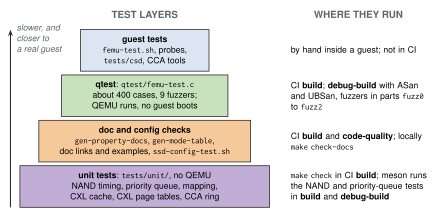
Figure: FEMU's test layers, fastest at the bottom: unit tests without QEMU, doc and config checks, qtests that run QEMU without a guest, and guest tests run by hand.
Build for testing
The qtests and the documentation checks need QEMU and qos-test. A debug
build is the usual choice:
mkdir build && cd build
../configure --target-list=x86_64-softmmu --disable-docs --enable-debug --enable-slirp
ninja qemu-system-x86_64 tests/qtest/qos-test
Unit tests
Without a QEMU build, from the source tree:
make -C hw/femu/tests check
make -C hw/femu/tests clean
This compiles the NAND media, hybrid mapping, CXL cache, page table entry
and caching API ring tests against a stub qemu/osdep.h and runs them, in
about a second. The CXL cache test needs GLib development files and is
skipped without them. In a configured build directory, meson runs the NAND
media, priority queue and hybrid mapping tests against QEMU's real headers.
CI runs both:
cd build
./pyvenv/bin/meson test test-femu-nand-media test-femu-pqueue test-femu-hybrid-oracle \
    --print-errorlogs
Device tests (qtest)
From the build directory, run every FEMU qtest:
QTEST_QEMU_BINARY=./qemu-system-x86_64 ./tests/qtest/qos-test -m quick \
    -p /x86_64/pc/i440FX-pcihost/pci-bus-pc/pci-bus/femu/femu-tests
List them, or run one by its full path:
QTEST_QEMU_BINARY=./qemu-system-x86_64 ./tests/qtest/qos-test -l |
    sed -n 's|^# \(.*femu-tests/.*\)|\1|p'
QTEST_QEMU_BINARY=./qemu-system-x86_64 ./tests/qtest/qos-test -m quick \
    -p /x86_64/pc/i440FX-pcihost/pci-bus-pc/pci-bus/femu/femu-tests/cc-states
Each case starts its own QEMU under the qtest accelerator, so no KVM and no
guest are needed. The default device is a 64 MiB NoSSD controller at PCI
address 04.0; a case can add its own device options. The CXL cases start
their own machine with a femu-cxl-ssd, which the x86_64-softmmu build
includes by default.
Sanitizer build
CI also runs the unit tests and qtests in a build with AddressSanitizer, UndefinedBehaviorSanitizer and the FTL invariant checks on. A bound violation that the normal build silently survives aborts there:
mkdir build-debug && cd build-debug
../configure --enable-kvm --target-list=x86_64-softmmu --enable-slirp \
    --disable-libnfs --disable-libiscsi --disable-curl \
    --enable-asan --enable-ubsan --extra-cflags=-DFEMU_FTL_ASSERT
make -j"$(nproc)"
Run the qtests in that build with the sanitizer options CI uses. Without
abort_on_error=1, a sanitizer report does not fail the test:
export ASAN_OPTIONS=detect_leaks=0:abort_on_error=1
export UBSAN_OPTIONS=print_stacktrace=1:halt_on_error=1
QTEST_QEMU_BINARY=./qemu-system-x86_64 ./tests/qtest/qos-test -m quick \
    -p /x86_64/pc/i440FX-pcihost/pci-bus-pc/pci-bus/femu/femu-tests
The fuzz cases (names containing fuzz) take most of the sanitized run
time, and CI splits them over three jobs.
Documentation checks
From the source tree, with the build above in build/:
make -C hw/femu/tests check-docs
It regenerates the property reference and mode tables and compares them,
checks every relative link, and runs every example tagged
femu-example under qtest. Set QEMU= and QOS_TEST= for a build
elsewhere. docs-maintenance.md says
how to tag a new example.
Guest-side tests
These need a booted guest; CI does not run them. Copy the files into the
guest first, for example with scp -P 8080 and the key from
make-guest-image.sh.
femu-test.sh checks one namespace end to end: data written comes back,
the counters move, deallocate works, and zones or key-value commands answer
when the namespace has them. It overwrites the whole namespace:
sudo bash femu-test.sh --yes /dev/nvme0n1
It prints PASS, FAIL and SKIP lines and a summary, and exits non-zero
when a check failed, so it can gate a script. A read that fails counts as a
failure, the same as a bad checksum. It refuses a mounted device. A
key-value namespace has no block node, so it is driven by passthrough
through its generic node, /dev/ngXnY; name it as /dev/nvmeXnY or
/dev/ngXnY. It makes no timing claims. A BlackBox run prints lines like
these (N stands for the counts; ... for lines left out here).
max_block_reads is the read count of the most-read block since its
erase:
== device ==
  PASS  controller answers Identify
== data survives the FTL ==
  PASS  random write then verify (crc32c)
== deallocate ==
  PASS  deallocate accepted
  ...
== counters ==
  PASS  SMART log readable
  data_units_written=N host_write_commands=N
  ...
  waf_x1000=N host_pages=N nand_pages=N max_block_reads=N read_reclaims=N
  PASS  host writes counted
  PASS  write amplification reported

FEMU_TEST pass=N fail=0 skip=N
Smaller probes, built in the guest with gcc -O2 -o NAME NAME.c:
| Probe | Run | Checks |
|---|---|---|
kv-probe.c | sudo ./kv-probe /dev/nvme0 | key-value Store, Exist, Retrieve and Delete |
aer-probe.c | sudo ./aer-probe /dev/nvme0 | a temperature event completes an Asynchronous Event Request |
zone-aen-probe.c | sudo ./zone-aen-probe /dev/nvme0 /dev/nvme0n1 | Zone Descriptor Changed notices, on a ZNS device with err_write_fail_ppm set |
Mode-specific suites:
- FDP:
fdp-test-nvme-admin.shchecks the FDP admin commands against the devicerun-blackbox-fdp.shcreates. - CSD: the programs and guest tool in
hw/femu/tests/csd/(CSD guide). - CXL caching API:
hw/femu/tools/cca/run-guest-tests.sh(CCA guide).
All of them are listed in the scripts reference.
Adding a test
A qtest
-
Write a function in
hw/femu/tests/qtest/femu-test.cwith the signaturestatic void femu_test_NAME(void *obj, void *data, QGuestAllocator *alloc).objis theQFemudevice; the existing helpers enable the controller, create queues and submit commands. Read a similar case first. -
Register it in
femu_register_nodes(). For the default device:qos_add_test("my-case", "femu", femu_test_my_case, NULL);For other device options:
qos_add_test("my-bbssd-case", "femu", femu_test_my_case,&(QOSGraphTestOptions) {.edge.extra_device_opts ="serial=my-bbssd-case,devsz_mb=4,femu_mode=1,secs_per_pg=8,""pgs_per_blk=4,blks_per_pl=128,pls_per_lun=1,luns_per_ch=2,nchs=2"}); -
Rebuild
tests/qtest/qos-testand run the case by its path. -
Show that it can fail: revert your fix, or plant the bug it is meant to catch, and check that the case goes red.
A unit test
Put it in hw/femu/tests/unit/ and add it to UNIT_TESTS, a build rule
and the clean rule in hw/femu/tests/Makefile. If it should also build against QEMU's
headers, add it to femu_unit_tests in hw/femu/tests/meson.build.
A documentation example
Put the command line in a code block with a femu-example tag. The check
starts it, enables each controller, and writes and reads one block. See
docs-maintenance.md.