NAND media and timing model
This page is hw/femu/docs/design/nand-timing.md at FEMU 39a55eeb6 (2026-10-02), licensed GPL-2.0-or-later. Send corrections to the FEMU repository.
This chapter describes the component that decides how long a flash operation takes in FEMU. It covers the geometry the model works on, the time it charges for a page read, a page program and a block erase, how operations on the same die, plane or channel wait for each other, and how those times become the completion time of an NVMe command. It also covers the two models that sit after the media: the host link and the controller firmware CPU.
The timing model concept page explains the same model from the user's side. This page is for readers who want the algorithms, the data structures and the source.
Contents
- Purpose and place in FEMU
- Geometry
- Data structures
- Operation timing
- Cell types and page types
- Channel bus
- Plane parallelism and multi-plane operations
- Program and erase suspend
- ECC read time
- From operations to a completion time
- How garbage collection is charged
- Host link and firmware CPU
- OCSSD timing model
- Runtime switches
- Parameters
- Statistics
- Calibrating against a real device
- Validation status
- What is not modelled
- Adding a timing feature
- Source map
Purpose and place in FEMU
FEMU copies a command's data as soon as it parses the command. Timing is computed separately: a model works out when the command would have finished on the emulated device, and the poller holds the completion until the host clock reaches that time. The NAND media model is the part of that computation that charges flash operations.
There are two media engines:
- The media layer,
nand_media_op()inhw/femu/nand/nand-media.c. BBSSD, CSD, KV, ZNS and the FTL behind afemu-cxl-ssduse it. It never includes a controller header. Each mode decodes its own address into aNandLoc, gives the layer a configuration, and lends it pointers to its busy-until fields. - The OCSSD model,
hw/femu/timing-model/timing.c. Open-Channel 1.2 and 2.0 use it. It is older, keeps its state in the controller, and is described in OCSSD timing model.
 guest NVMe command
        |
        v
 +--------------------+   stamps stime, copies data
 | poller (nvme-io.c) |------------------------------------------+
 +--------------------+                                          |
        | to_ftl ring                                            |
        v                                                        |
 +--------------------+   per mode: page list -> NAND ops        |
 | FTL                |   bbssd/ftl-datapath.c, zns/zftl.c,      |
 | (FTL thread, or    |   kvssd/kvssd-ftl.c (in the poller)      |
 |  poller for KV)    |                                          |
 +--------------------+                                          |
        | NandLoc + op + stime                                   |
        v                                                        |
 +--------------------+   array time, gates, bus phases,         |
 | NAND media layer   |   suspend, ECC; returns done - stime     |
 | nand/nand-media.c  |                                          |
 +--------------------+                                          |
        | per-command latency = max over its operations          |
        v                                                        |
 expire_time = stime + latency                                   |
        |                                                        |
        v                                                        |
 +--------------------+   host link, firmware CPU, then the      |
 | poller completion  |   priority queue by expire_time  <-------+
 +--------------------+
        |
        v
 CQE posted on the first sweep at or after expire_time
| Mode | Engine | Built in | Called from |
|---|---|---|---|
| BBSSD, CSD | media layer | bb_nand_media_init() in bbssd/ftl-media.c | FTL thread |
| KV | media layer, through the BBSSD wrapper | ssd_init() from kvssd/kvssd-ftl.c | poller |
| ZNS | media layer | zns_nand_media_init() in zns/zftl.c | FTL thread |
femu-cxl-ssd | media layer, through the BBSSD wrapper | femu_cxl_start() in cxlssd/cxlssd.c | femu-cxl-ftl worker |
| OCSSD 1.2, 2.0 | timing-model/timing.c | init_nand_flash() | poller |
| NoSSD | none |
Geometry
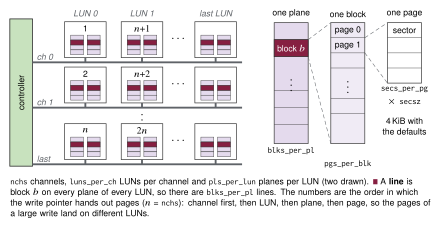
Figure: The NAND hierarchy (channel, LUN, plane, block, page, sector), a line as one block index across every plane of every LUN, and the order in which the write pointer hands out pages.
Every mode that models NAND describes it with the same hierarchy. Only the names of the properties and the field widths differ.
 device
 +-- channel 0 .. nchs-1             one shared bus per channel
     +-- LUN 0 .. luns_per_ch-1      a die: runs one array operation at a time
         |                           (one per plane under the ZNS plane gate)
         +-- plane 0 .. pls_per_lun-1
             +-- block 0 .. blks_per_pl-1   erase unit
                 +-- page 0 .. pgs_per_blk-1  program and read unit
                     +-- sector 0 .. secs_per_pg-1  (secsz bytes each)

 BBSSD line (superblock) k = block k on every (channel, LUN, plane)
 lines = blks_per_pl     pages per line = nchs * luns_per_ch * pls_per_lun * pgs_per_blk
Address formats
| Mode | Address | Fields, low bit first | Where |
|---|---|---|---|
| BBSSD, CSD, KV | struct ppa | blk 16, pg 16, sec 8, pl 4, lun 7, ch 12, reserved 1 | bbssd/ftl.h |
| ZNS | struct ppa | spg 2, pg 16, blk 16, fc (LUN) 8, pl 3, ch 7, valid 1, reserved 8 | zns/zns.h |
| OCSSD 1.2 | 64-bit PPA with masks and offsets from the geometry | ch, lun, pln, blk, pg, sec | PPA_* macros in nand/nand.h |
| OCSSD 2.0 | 64-bit LBA with group, parallel unit, chunk, sector fields | group, PU, chunk, sector | OC20_LBA_GET_* in ocssd/ |
A field width is an upper bound on its axis. bb_check_geometry() in
bbssd/ftl-geom.c refuses a count larger than its field can hold, and refuses
a geometry whose total sector count does not fit in a signed 32-bit integer.
zns_check_params() bounds each ZNS axis by its field. oc_timing_geometry_ok()
requires every OCSSD axis to be non-zero, lnum_ch at most 32 and
lnum_ch * lnum_lun at most 128, the sizes of the per-chip arrays.
How pages land on the geometry
The timing a workload sees depends on where the FTL puts its pages, because the media model only charges what it is asked to.
- BBSSD, CSD, KV allocate from a write pointer that moves channel first,
then LUN, then plane, then page
(
ssd_advance_write_pointer_common()inbbssd/ftl-line-gc.c). Consecutive pages of a large write therefore land on different channels, then different LUNs, and are programmed in parallel. - ZNS buffers writes in a per-zone write cache. A flush programs one
program unit per plane:
zns_flash_typepages of 16 KiB (ZNS_PAGE_SIZE) per plane, charged as one program operation per plane (zns_wc_flush()inzns/zftl.c). A 4 KiB logical page is a sub-page (spg) of a 16 KiB page. - OCSSD takes physical addresses from the host, so the host chooses the parallelism.
Data structures
The media layer's types are in hw/femu/nand/nand-media.h.
| Type | Fields that matter | Role |
|---|---|---|
NandLoc | ch, lun, pl, blk, pg, flash_type, page_type, pe_cycles, age_sec | One operation's position and the facts timing depends on. Filled by the mode's decoder (bb_decode_loc(), zns_advance_status()). |
NandMediaTiming | rd_ns, wr_ns, er_ns (flat); rd_table_ns, wr_table_ns, er_table_ns (by cell and page type); pgtype_mult; cmd_addr_ns, page_xfer_ns, status_ns; tplebsy_ns and three unused multi-plane and cache-read times; ecc_*; tsusp_ns | Every duration. |
NandMediaPolicy | array_gate, channel_mode, pe_suspend, ecc_on_read, use_flat_timing, cache_read | Which mechanisms are on. |
NandTimelineOps | ch_avail, lun_avail, plane_avail, page_reg_ready, lock_lun, unlock_lun | Accessors that return pointers into the mode's own busy-until fields. |
NandMedia | cfg, bus_res (per-channel booked windows), susp (per-position suspend state) | One instance per namespace FTL. |
NandOpCompletion | done_ns, latency_ns | Absolute end time, and done_ns - stime. |
The busy-until times ("availability timestamps") live in the mode's structures, not in the media layer:
| Resource | BBSSD, CSD, KV | ZNS | OCSSD |
|---|---|---|---|
| Channel bus | ssd_channel.next_ch_avail_time | zns_ch.next_ch_avail_time | FemuCtrl.chnl_next_avail_time[] plus chnl_reservations[] |
| LUN (die) | nand_lun.next_lun_avail_time | zns_fc.next_fc_avail_time (never consulted) | FemuCtrl.chip_next_avail_time[] |
| Plane | not kept | zns_plane.next_plane_avail_time | not kept |
Each mode configures the layer differently:
| Setting | BBSSD, CSD, KV, CXL | ZNS |
|---|---|---|
array_gate | NAND_GATE_LUN_ONLY | NAND_GATE_PLANE_ONLY |
channel_mode | NAND_CH_STAGED when any bus phase is non-zero, else NAND_CH_OFF | same rule |
use_flat_timing | true when nand_cell_type=0, false with a cell type | false (per-type table, page type always 0) |
pe_suspend | pe_suspend property | zns_pe_suspend property |
ecc_on_read | true; the adder is still 0 unless ecc_step_ns is set | false |
cache_read | false | false |
The enum also has NAND_CH_NOOP and NAND_GATE_LUN_AND_PLANE. No mode
selects either today.
Operation timing
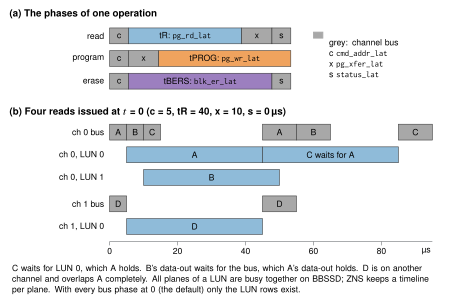
Figure: How the media layer times an operation: the phases of a read, program and erase, and four reads issued together showing LUN serialization, a shared channel bus and parallel channels.
Array time
array_lat() picks the time the die spends on the operation:
 erase   : flat ? er_ns : er_table_ns[flash_type]
 read    : (flat ? rd_ns : rd_table_ns[flash_type][page_type]) + ecc_extra
 program : flat ? wr_ns : wr_table_ns[flash_type][page_type]
           if flat and pgtype_lat:  * pgtype_mult[page_type] / 1000
Phase sequence of one operation
With the channel bus off (the default), an operation is one array phase:
 start = max(stime, gate busy-until)
 done  = start + array time
 gate busy-until = done
With the bus on (NAND_CH_STAGED), each operation also has bus phases.
"Now" phases queue on the bus in arrival order; a read's data-out happens
after the array finishes, so it is booked as a future window
(Channel bus).
 READ     |cmd/addr|..wait for die..|=== tR array ===|data-out|status|
           bus now                   die              bus later  bus later

 PROGRAM  |cmd/addr|data-in|..wait for die..|======= tPROG array =======|
           bus now  bus now                   die  (done = array end)

 ERASE    |cmd/addr|..wait for die..|=========== tBERS array ===========|status|
           bus now                   die                                 bus later
A program completes when its array phase ends. A read completes after its
status phase, an erase after its status phase. A zero-length phase touches
nothing, so a bus with only pg_xfer_lat set has no command or status cost.
Default times
| Mode | Read | Program | Erase | Source |
|---|---|---|---|---|
BBSSD, CSD, KV flat (nand_cell_type=0) | pg_rd_lat 40 us | pg_wr_lat 200 us | blk_er_lat 2 ms | property defaults in femu.c |
femu-cxl-ssd | read-ns 40 us | program-ns 200 us | erase-ns 2 ms | cxlssd/qemu-adapter.c |
| ZNS SLC | 4 us | 75 us | 2 ms | zns/zns.h, erase from nand/nand.h |
| ZNS TLC | 32 us | 937.5 us | 3 ms | same |
ZNS QLC (default zns_flash_type) | 85 us | 12.196 ms | 3 ms | same |
| ZNS MLC, PLC | none built in | none built in | none built in | realize refuses them unless all three zns_*_lat are set |
The ZNS program time covers a whole program unit (zns_flash_type pages of
16 KiB on one plane). The header cites the ISSCC papers the figures come from.
Cell types and page types
BBSSD, CSD, KV: nand_cell_type
nand_cell_type | Cell | Read by page type (us) | Program by page type (us) | Erase |
|---|---|---|---|---|
| 0 | flat | pg_rd_lat | pg_wr_lat, optionally scaled by pgtype_lat | blk_er_lat |
| 1 | SLC | 40 | 800 | 2 ms |
| 2 | MLC | lower 48, upper 64 | lower 850, upper 2300 | 3 ms |
| 3 | TLC | 56.5, 77.5, 106 | 820.5, 2225, 5734 | 3 ms |
| 4 | QLC | 59.325, 85.25, 127.2, 169.6 | 861.525, 2447.5, 6880.8, 9174.4 | 3 ms |
Values come from nand/nand.h: MLC from a profile of Micron L95B parts, TLC
from SimpleSSD, QLC scaled from the TLC values. Any other value is reset to 0
with a message (ssd_init() in bbssd/ftl.c); PLC has no table here. With a
cell type set, pg_rd_lat, pg_wr_lat and blk_er_lat no longer set NAND
times (pg_rd_lat still sets the write buffer and read cache hit cost), and
pgs_per_blk must be at most 512, the size of the page-type tables.
The page type of page pg in a block comes from the pairing tables
mlc_tbl, tlc_tbl and qlc_tbl, built by init_nand_flash() in
nand/nand.c; slc_tbl is all zeros. They follow a shadow programming order: the first pages of
a block are lower pages, then consecutive pairs of pages cycle through the
page types from lower to upper.
BBSSD, CSD, KV: pgtype_lat and cell_pages
With nand_cell_type=0 and pgtype_lat non-zero, the flat program time is
multiplied by a factor that depends on the page's position in its wordline.
The page type is pg % cell_pages; cell_pages 0 is set to 3 when
pgtype_lat is on (ssd_init()). The factors, in thousandths, are in
bb_nand_media_init():
cell_pages | Page type 0 | 1 | 2 | 3 | 4 |
|---|---|---|---|---|---|
| 1 | 1000 | ||||
| 2 | 600 | 1400 | |||
| 3 | 600 | 1000 | 1400 | ||
| 4 | 500 | 850 | 1150 | 1500 | |
| 5 | 400 | 750 | 1000 | 1250 | 1600 |
Each row averages to 1000, so the mean program time stays pg_wr_lat when
pgs_per_blk is a multiple of cell_pages.
Reads and erases are not scaled.
ZNS and OCSSD
ZNS keeps one read, program and erase time per cell type and always uses page
type 0. Each zns_*_lat property replaces the built-in value for the
configured zns_flash_type only. OCSSD uses the nand_cell_type tables
above, selected by flash_type; Open-Channel 1.2 looks up the page type of
each page, Open-Channel 2.0 always uses page type 0.
Channel bus
The bus is modelled only when a phase has a duration: cmd_addr_lat,
pg_xfer_lat (or ch_xfer_lat when pg_xfer_lat is 0) or status_lat for
BBSSD, CSD and KV; zns_cmd_addr_lat, zns_pg_xfer_lat or zns_status_lat
for ZNS. Otherwise transfers take no time and channels never contend.
Two kinds of phase share a channel:
bus_now(): command/address, a program's data-in. It starts atmax(earliest, ch_avail), moves past any booked window it would overlap, and advancesch_availto its end.bus_later(): a read's data-out and status, which happen after the array finishes. It starts no earlier thanch_availand is booked as a window[start, end)inbus_res[ch]and does not advancech_avail, so another die's "now" phase can use the bus before the window opens.
Windows that ended before the current operation's stime are pruned. A
channel holds at most NAND_BUS_RES_MAX (32) windows; when it is full, the
data-out is charged FIFO from ch_avail instead.
 channel 0 bus, cmd/addr 1 us, data 10 us (times in us)

 0   1        11 12 13                 52        62
 |P c|P data-in|R1c|R2c|.... idle .....|R1 out   |
                                       ^ booked window, R1's array ended at 52
 a phase that arrives at 20 fits in the idle gap; one that would overlap
 [52,62) moves to 62
Plane parallelism and multi-plane operations
The array gate decides which operations exclude each other:
 LUN gate (BBSSD, CSD, KV)             plane gate (ZNS)
 LUN 0: [pl0 op][pl1 op][pl0 op]       LUN 0 pl0: [op][op]
        one at a time per LUN                pl1: [op][op]  in parallel
Under the LUN gate, all planes of a LUN are busy together, so
pls_per_lun > 1 adds capacity and line width but no single-operation
parallelism, except for the one batched operation below.
nand_media_multiplane() runs one operation on several planes of a LUN:
 per plane i:  cmd/addr on bus (+ data-in for a program); tplXbsy between planes
 array:        start = max(bus end, gate of every plane); done = start + array time
 read:         status, then per plane cmd/addr + data-out (booked windows)
 program/erase: status (if set)
| Operation | Batched across planes | Caller |
|---|---|---|
| Erase of a line's block on every plane of a LUN | yes, one erase time plus tplebsy per extra plane | BBSSD GC (bbssd/ftl-line-gc.c), FDP GC (bbssd/ftl-fdp.c), KV reclaim (kvssd/kvssd-ftl.c) |
| Host reads and programs | no, one operation per page | bbssd/ftl-datapath.c |
| GC page moves | no | gc_read_page(), gc_write_page() |
| ZNS zone reset | no batching needed: each plane has its own gate, so per-plane erases overlap | zns_zone_reset() |
Copyback (nand_media_copyback()) | not called | none |
tplpbsy, tplrbsy and trcbsy are accepted for compatibility and have no
effect; setting them warns at realize. With the defaults (no bus, no
tplebsy) a two-plane erase takes exactly one erase time.
Program and erase suspend
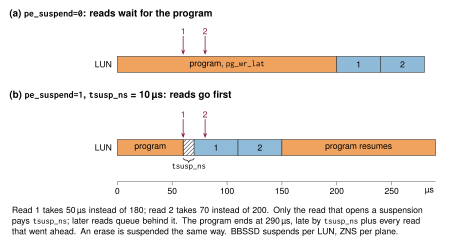
Figure: Program suspend on one LUN: with pe_suspend=1 two reads go ahead of a running program, the first pays tsusp_ns, and the program finishes later by that overhead plus both reads.
With pe_suspend (BBSSD, CSD, KV) or zns_pe_suspend (ZNS), a read that
finds its LUN (ZNS: plane) running a program or erase goes ahead of it. The
layer keeps, per position, pe_end (when the newest program or erase there
ends) and rd_end (when the newest read there ends). suspend_read_start()
decides:
 read arrives at t, gate busy until B
 if t >= B or t >= pe_end:           ordinary gate (nothing to suspend)
 elif rd_end > t:                    join the open suspension
     start = rd_end,      shift = tR
 else:                               open a suspension
     start = t + tsusp,   shift = tR + tsusp
 done = start + tR
 pe_end += shift; every gate busy-until > t += shift; rd_end = done
Only programs and erases are suspended: a read that finds the die busy with
another read waits for it. Reads that queue behind an open suspension pay
tsusp_ns once. A read that arrives after the suspension's reads have ended
opens a new one and pays it again.
Worked example, one LUN, pg_wr_lat 200 us, pg_rd_lat 40 us,
tsusp_ns 5 us, bus off. Numbers produced by nand_media_op():
 time (us)   0        50 55    95     135  150 155   195             330            530
 LUN busy    |== P ===|ss|  R1  |  R2  |= P =|ss| R3 |====== P ======|===== W2 =====|

 P  program  arrives 0     runs 0-50, 135-150, 195-330 (suspended twice)
 R1 read     arrives 50    opens a suspension: starts 50 + 5, done 95
 R2 read     arrives 60    joins it behind R1: starts 95, done 135, no tsusp
 R3 read     arrives 150   R1 and R2 are over, so it opens a new one: 155-195
 W2 program  arrives 160   waits for the LUN until P ends: 330-530
 (ss = tsusp_ns)

 P's die time: 200 alone; with the reads 200 + (5+40) + 40 + (5+40) = 330
P's own command still completes at 200. Its latency was computed when it was issued and is never revisited. Suspension moves only the die's busy-until time, from 200 to 330, so operations issued afterwards, such as W2, start after 330. A suspended program or erase never makes its own command complete afterwards; it delays the commands that follow.
nand_media_multiplane() does not consult the suspend state, so a read
issued through it never suspends; only erases use it today. The state is
read and written without a lock, so operations on one position must be
serialized. BBSSD and ZNS run them on the single FTL thread. A device
with suspend on also leaves the lock-free fast path described in
Concurrency.
ECC read time
ecc_step_ns adds read time for worn or old data (ecc_extra_ns()):
 tiers = pe_cycles / 750  +  age_sec / ecc_retention_sec   (second term only if set)
 tiers = min(tiers, 4)
 extra read time = tiers * ecc_step_ns
pe_cycles is the block's erase count, age_sec the time since its line was
filled (line.close_time). The constants are FEMU_ECC_PE_PER_TIER and
FEMU_ECC_MAX_TIERS in bbssd/ftl.h. A multi-plane read pays the largest
extra of its planes. Read-retry as a sequence of separate array reads is not
modelled; this adder stands in for it. ZNS and OCSSD have no ECC time.
From operations to a completion time
The per-operation rule
For every resource the operation needs, it starts no earlier than that resource's busy-until time, and it moves the resource's busy-until time to when it stops using it. With the bus off and the LUN gate this reduces to:
 done(op)      = max(stime, lun_avail) + array_time(op)
 lun_avail     = done(op)
 latency(op)   = done(op) - stime
stime is the command's submission time, stamped by the poller from
QEMU_CLOCK_REALTIME (nvme-io.c; a test-only property switches it to the
virtual clock). Background work (GC) passes stime = 0,
which the wrappers replace with the current time.
The per-command rule
The FTL issues all of a command's NAND operations with the command's stime
and returns the largest latency:
 latency(cmd) = max over the command's operations of latency(op)
                (and of write buffer, read cache and mapping cache costs)
 expire_time  = stime + latency(cmd)            femu_ftl_thread(), femu.c
Then the poller adds the optional host link and firmware CPU
models and queues the request in a priority queue ordered by expire_time.
The completion is posted on the first poller sweep at or after it.
Worked example: operations overlapped across LUNs and channels
Geometry 2 channels by 2 LUNs, 1 plane, flat 40 us read and 200 us program,
staged bus with cmd_addr_lat=1000 and pg_xfer_lat=10000. Four operations
arrive at time 0 in this order. The numbers are what nand_media_op()
returns.
 op   target       arrives
 P    ch0 LUN0     0       program
 R1   ch0 LUN1     0       read
 R2   ch0 LUN0     0       read (same LUN as P)
 R3   ch1 LUN0     0       read (other channel)

 time (us)   0 1   11 12 13      51 52  62          211        251 261
 ch0 bus     |c|-d--|c |c |       .  |o1-|            .          |o2-|
             P P    R1 R2             R1             .           R2
 ch0 LUN0      .    [===== P tPROG 200 ======================)[R2 tR )
 ch0 LUN1           [R1 tR 40)
 ch1 bus     |c|                 |o3-|
 ch1 LUN0      [R3 tR 40)

 done:  P 211   R1 62   R2 261   R3 51
- P: command 0-1, data-in 1-11, array 11-211.
- R1: its command waits for P's data-in (11-12), its array runs on the idle LUN1 (12-52), its data-out is booked 52-62.
- R2: command 12-13, then waits for LUN0 until P ends at 211, array 211-251, data-out 251-261.
- R3: on channel 1, which nothing else uses: 0-1, 1-41, 41-51.
With the bus off, the same four operations end at P 200, R1 40, R2 240,
R3 40. With pe_suspend=1 and tsusp_ns=5000, R2 suspends P instead: it
starts at 13 + 5 = 18, ends its array at 58, waits for R1's booked window and
moves its data at 62-72 (done 72), and the die stays busy until 256. P's
own completion stays at 211.
If R1 and R2 were the two pages of one 8 KiB read command, its media latency would be max(62, 261) = 261 us.
Worked example: full command completion
A host read of two written 4 KiB pages on idle LUNs of the default BBSSD (bus off),
with pcie_bandwidth_mbps=4000, pcie_prop_delay_ns=500 and
fw_cpu_ns=1000, submitted at time S:
 S                       stime stamped by the poller
 S + 40 000              FTL: max(40 000, 40 000) -> expire_time
 S + 40 000 .. 42 048    link: 8192 B * 1000 / 4000 MB/s = 2 048 ns on the
                         device-to-host queue (starts at max(queue free, expire))
 S + 42 548              + propagation 500 ns
 S + 42 548 .. 43 548    firmware core: max(core free, expire) + 1 000 ns
 S + 43 548              expire_time; CQE posted on the first sweep at or after it
The link and firmware queues are shared by every command of the controller, so under load each command also waits for the ones queued before it on those queues.
Concurrency
- BBSSD and ZNS call the layer from the single
FEMU-FTL-Thread, so their timelines need no lock. KV calls it from the poller andfemu-cxl-ssdfrom itsfemu-cxl-ftlworker, each under its own device lock. - With the LUN gate, no bus and no suspend,
nand_media_op()updatesnext_lun_avail_timewith a compare-and-swap loop that gives the same result as a locked read-max-add-store. Any other configuration takes the general path, which callslock_lun/unlock_lunwhen the mode provides them; BBSSD and ZNS do not. - The OCSSD model takes a spinlock per chip and per channel.
How garbage collection is charged
GC operations go through the same timelines as host operations, with
stime = 0 (the current time) and type = GC_IO:
gc_read_page()charges a read of each valid page,gc_write_page()a program at its new location, andreclaim_line()one multi-plane erase per LUN (bbssd/ftl-line-gc.c). All of a victim's pages are moved before any of its blocks is erased, so the erases follow the last relocation. FDP GC does the same inbbssd/ftl-fdp.c.- The returned latency is discarded. GC never adds to a command's latency directly. It makes LUNs and channels busy, and the host operations that need them afterwards wait.
- Foreground GC runs when the share of used lines has reached
gc_thres_pcent_high: at the start ofssd_write(), and before each page that a write, a write buffer destage or a Write Zeroes programs (bbssd/ftl-datapath.c), until the share drops below it. The command's own programs then queue behind the GC operations on the LUNs they share. - Read reclaim (
read_reclaim_limit,retention_limit_sec) rewrites one queued line throughreclaim_line()at the start of a write, charged the same way as GC. - Background GC runs one victim after a request finishes in
bb_ftl_process_req()(bbssd/ftl.c), once the latency of that request has been computed. It delays the commands that follow. - Because GC is stamped with the current time and a host command with its submission time, a command submitted before a GC pass can still wait for it when the FTL thread gets to the command after the pass.
- GC time can be turned off with 0xEF code 2 (Runtime switches). GC still moves pages and erases blocks; its operations are then not charged at all.
 LUN 3 timeline during foreground GC for one write (bus off)
 |-- GC read --|-- GC program --| ... |== multi-plane erase ==|-- host program --|
 ^ write arrives                                                                  ^ write's done
KV is different. Its reclaim erases and compaction moves are stamped with
the triggering command's stime, the command completes when the last of
them and of its own operations does (kvssd/kvssd-ftl.c), and 0xEF does not
apply to KV, so they cannot be switched off.
ZNS has no device GC. A Zone Reset charges one erase per block of the zone on
every plane it spans, with the command's stime, and returns the largest
(zns_zone_reset()).
Costs that are not NAND operations
The FTL adds these to a command's latency alongside its NAND operations:
- BBSSD write buffer (
buffer_size> 0): a write the buffer accepts costspg_rd_lat / 16(1 us whenpg_rd_latis 0), plus the programs of any destage it forces. A Flush pays for programming everything buffered (bbssd/ftl.c). A read of a buffered page costs the same DRAM access. - BBSSD read cache and DFTL mapping cache: a hit costs a DRAM access; a mapping miss adds a NAND read of the translation page, after a program if the evicted entry is dirty.
- ZNS write cache: a write only enters the zone's write cache and pays
SRAM_WRITE_LATENCY_NS(1 us) per 4 KiB page, summed over the command (zns_write()inzns/zftl.c). It pays program time only when the cache fills, or when it has to evict another zone's cache. A cache holds one stripe: 16 KiB *zns_flash_type*zns_num_plane*zns_num_ch*zns_num_lun. A read of data still in the cache is not mapped yet and costs nothing.
Host link and firmware CPU
Both are applied in nvme_process_cq_cpl() in hw/femu/nvme-io.c, after the
media latency is in expire_time and before the request enters the priority
queue. Both are off by default.
| Model | Applies to | Computation |
|---|---|---|
Link transfer (pcie_bandwidth_mbps) | NVMe Read and Write (opcodes 01h and 02h) in BBSSD, CSD, KV, ZNS and NoSSD; KV store and retrieve share those opcodes and use the bytes moved. Not Zone Append, and not the Open-Channel vector commands, so OCSSD 1.2 never pays it | trans = bytes * 1000 / MBps ns. One queue per direction: writes on pcie_rx_next_avail_time, reads on pcie_tx_next_avail_time. start = max(queue, expire), queue = start + trans |
Propagation (pcie_prop_delay_ns) | same | expire = queue + delay; does not occupy the queue |
Firmware CPU (fw_cpu_ns) | Read, Write (01h, 02h) and Zone Append; not the Open-Channel vector commands | one modelled core: start = max(core, expire), core = start + fw_cpu_ns, expire = core |
The link is modelled after the media for both directions. A read's transfer
to the host never overlaps its NAND time, and a write's transfer from the
host is charged after its programs, not before them. The firmware cost is charged at the end of a command,
which caps the command rate at about one per fw_cpu_ns but does not delay
the start of the media operations. The link model is enabled when either link property is non-zero
(pcie_enabled in femu.c).
OCSSD timing model
Open-Channel devices use hw/femu/timing-model/timing.c:
advance_chip_timestamp(): per chip (flat LUN idch * num_lun + lun), if the chip is busy, its busy-until time grows by the operation time; otherwise it becomesnow + time. That is the same asmax(now, busy) + time. Times come from theflash_typetable.advance_channel_timestamp()books a transfer FIFO on the channel;advance_read_channel_timestamp()books a read's data-out as a future window, the same idea asbus_later().- A write moves its data over the channel, then programs the chip. A read occupies the chip, then moves its data out. Erase charges each chip in the address list.
- Open-Channel 1.2 charges a channel transfer only with
oc12_channel_timing=on:ch_xfer_latns per page, or the table value forflash_typewhen it is 0, scaled by the sectors used out oflsecs_per_pg. Open-Channel 2.0 charges no channel time and uses page type 0. - Open-Channel 1.2 charges one chip operation per NAND page of the address list. Open-Channel 2.0 groups addresses that differ only in the sector field, which spans the whole chunk, so a run of consecutive sectors in one chunk pays one chip operation whatever its length.
- The latency is
max over operations of (done - stime), written straight intoexpire_timein the poller (oc12_advance_status(),oc20_advance_status()). - Open-Channel 1.2 keeps its data-out windows in an unbounded list per channel, where the media layer caps its list at 32.
Runtime switches
A BBSSD controller accepts the vendor admin command 0xEF (bb_flip() in
bbssd/bb.c). The action is in CDW10. For codes 1 to 4 it pauses the
pollers, applies the change to every namespace of the controller that has a
BBSSD FTL, and resumes them. Controllers of every other mode return Invalid
Opcode.
| CDW10 | Constant (bbssd/ftl.h) | Effect on timing |
|---|---|---|
| 1 | FEMU_ENABLE_GC_DELAY | GC operations are charged (default) |
| 2 | FEMU_DISABLE_GC_DELAY | GC operations are not charged |
| 3 | FEMU_ENABLE_DELAY_EMU | Flat read, program and erase set to the built-in 40 us, 200 us and 2 ms, not to the command-line values |
| 4 | FEMU_DISABLE_DELAY_EMU | Flat read, program and erase set to 0 |
| 5 | accounting reset | Prints and resets the per-poller completion counters; no timing change |
| 6, 7 | FEMU_ENABLE_LOG, FEMU_DISABLE_LOG | Per-command debug log on or off; no timing change |
Codes 3 and 4 refresh only the flat rd_ns, wr_ns and er_ns in the
media layer (bb_nand_media_refresh_timing()). With nand_cell_type 1 to 4
the flat times are not used, so the codes have no effect on NAND time. They
never change the channel bus phases, pgtype_lat, ECC time or
trim_lat_ns. Code 4 makes a write buffer hit cost 1 us; the read cache
keeps the hit cost it computed at start.
On a controller linked to a femu-cxl-ssd, codes 1 to 4 change the medium's
FTL instead, and code 3 restores its read-ns, program-ns and erase-ns.
From the guest:
sudo nvme admin-passthru /dev/nvme0 --opcode=0xef --cdw10=2   # stop charging GC
sudo nvme admin-passthru /dev/nvme0 --opcode=0xef --cdw10=4   # zero NAND times
The vendor command 0xEE (NVME_ADM_CMD_FEMU_DEBUG) sets an Open-Channel
controller's NAND times at run time, in nanoseconds: CDW10 upper page read,
CDW11 lower page read, CDW12 upper page program, CDW13 lower page program,
CDW14 block erase and CDW15 channel transfer per page. The lower page is
page type 0 and the upper page the highest page type of flash_type; the
centre pages of TLC and QLC keep their table times, and SLC, with one page
type, takes the lower page values. The times belong to that controller
(FemuCtrl.oc_pg_rd_lat and the fields beside it, filled from the
flash_type table by set_latency()), so other devices are not affected.
Other modes refuse 0xEE with Invalid Field.
sudo nvme admin-passthru /dev/nvme0 --opcode=0xee --cdw10=64000 --cdw11=48000 \
    --cdw12=2300000 --cdw13=850000 --cdw14=3000000 --cdw15=52433
Parameters
The generated property reference is the authority for types, defaults and ranges. This table groups the timing properties and states how they interact.
| Group | Properties | Interactions |
|---|---|---|
| Geometry | secsz, secs_per_pg, pgs_per_blk, blks_per_pl, pls_per_lun, luns_per_ch, nchs | nchs * luns_per_ch is the number of independent dies. pls_per_lun adds no read or program parallelism under the LUN gate. |
| Array times | pg_rd_lat, pg_wr_lat, blk_er_lat | Ignored when nand_cell_type is 1 to 4. 0xEF codes 3 and 4 overwrite them. pg_rd_lat / 16 is also the cost of a write buffer hit. |
| Cell type | nand_cell_type, cell_pages, pgtype_lat | pgtype_lat applies only with nand_cell_type=0. nand_cell_type limits pgs_per_blk to 512. |
| Bus phases | cmd_addr_lat, pg_xfer_lat, ch_xfer_lat, status_lat | Any non-zero value turns the bus on. pg_xfer_lat takes precedence over ch_xfer_lat. |
| Multi-plane | tplebsy (tplpbsy, tplrbsy, trcbsy have no effect) | Used only by multi-plane erase, so only with pls_per_lun > 1. |
| Suspend | pe_suspend, tsusp_ns | tsusp_ns matters only with pe_suspend. |
| ECC | ecc_step_ns, ecc_retention_sec | ecc_retention_sec matters only with ecc_step_ns. |
| Other FTL costs | trim_lat_ns | Charged per Dataset Management range by the FTL, not by the media layer. Refused with FDP. |
| ZNS | zns_num_ch, zns_num_lun, zns_num_plane, zns_num_blk, zns_flash_type, zns_pg_rd_lat, zns_pg_wr_lat, zns_blk_er_lat, zns_cmd_addr_lat, zns_pg_xfer_lat, zns_status_lat, zns_pe_suspend, zns_tsusp_ns | The zns_*_lat overrides apply to the configured cell type only. zns_num_plane scales the program unit. |
| OCSSD | flash_type, oc12_channel_timing, ch_xfer_lat, lnum_ch, lnum_lun, lnum_pln, lsecs_per_pg, lpgs_per_blk | ch_xfer_lat is shared with BBSSD. lnum_ch is at most 32 and lnum_ch * lnum_lun at most 128. |
| Host link and firmware | pcie_bandwidth_mbps, pcie_prop_delay_ns, fw_cpu_ns | Applied after the media time, to the opcodes listed in Host link and firmware CPU. |
femu-cxl-ssd | channels, luns-per-channel, pages-per-block, blocks-per-plane, read-ns, program-ns, erase-ns, channel-ns | One plane per LUN; feeds the same media layer. |
A BBSSD configuration with the bus and suspend on:
-device femu,devsz_mb=1024,femu_mode=1,cmd_addr_lat=1000,pg_xfer_lat=10000,pe_suspend=1,tsusp_ns=5000
A BBSSD with TLC page-type timing:
-device femu,devsz_mb=1024,femu_mode=1,nand_cell_type=3
Statistics
The media layer keeps no counters of its own. What it charges shows up in:
- Latency seen by the guest:
fiocompletion latency. This is the primary output of the model. - Vendor log page C0h (BBSSD, CSD): host, NAND and GC page counts, write amplification, buffer hits. See log pages and counters.
- Per-block counters used by the model:
nand_block.erase_cnt(ECC tiers, SMART Percentage Used) andnand_block.read_cnt(read reclaim), updated inssd_advance_status()and on erase. femu-cxl-ssd: the QOM countermedia-time-ns, the sum of the latencies the FTL returned. See runtime properties.- Debug:
nand_lun.gc_endtimerecords when the last GC operation on a LUN ends; nothing reports it.
Calibrating against a real device
- Take array times from the datasheet.
pg_rd_latis tR,pg_wr_latis tPROG,blk_er_latis tBERS. For a part with different lower and upper page times, either usenand_cell_typeif one of the built-in tables is close, or set the mean tPROG and turn onpgtype_latwithcell_pagesequal to bits per cell. - Derive the bus phases from the interface rate.
pg_xfer_latis the page size divided by the interface rate: a 16 KiB page on an 8-bit bus at 1600 MT/s takes 16384 / 1.6e9 s, about 10.2 us.cmd_addr_latandstatus_latare the command, address and status cycle times, usually well under 1 us. - Match the parallelism. Set
nchsandluns_per_chto the device's channels and dies per channel, andsecs_per_pg * secszto its page size. - Check the unloaded latency. Write the range first (a read of an unwritten page costs nothing), then run a queue depth 1 4 KiB random read. The median completion latency should be about tR plus the data-out and status phases plus guest and poller overhead. Measure that overhead once with flat timing, no bus phases, no caches and 0xEF code 4, and subtract it.
- Check the saturated throughput. A random read at high queue depth
should approach
nchs * luns_per_ch / tRoperations per second when the bus is not the limit, ornchs / (pg_xfer_lat + cmd_addr_lat + status_lat)when it is. Compare with the real device at the same queue depth. - Add the host side. If the real device's peak is below what the media
allows, set
pcie_bandwidth_mbpsto its link rate andfw_cpu_nsto the inverse of its peak command rate. - Check GC separately. Precondition the device, run sustained random writes, and compare the write amplification in log page C0h and the steady-state write bandwidth. Toggle 0xEF codes 1 and 2 to see how much of the gap GC time explains.
Give each poller and the FTL thread its own host core while measuring; performance tuning and measuring cover the setup.
Validation status
- Unit tests:
hw/femu/tests/unit/test-nand-media.cchecks the media layer's arithmetic without QEMU: ECC tiers, the staged bus and its booked windows, the plane gate with the bus, multi-plane erase against serial erases, copyback, and program/erase suspend. Run it withmake -C hw/femu/tests check. - qtests:
hw/femu/tests/qtest/femu-test.ccovers the OCSSD 1.2 channel model (oc12-channel-timing,oc12-channel-gap,oc12-channel-default,oc12-channel-off,oc12-ppa-timing,oc12-flash-type,oc12-page-count,oc12-transfer-cost), the warning for the timing properties that have no effect (ignored-props), the 0xEF flips on a linkedfemu-cxl-ssd(cxl-nvme-flip), and the two example configurations on this page (doc-examples). - Not covered by automated tests: BBSSD and ZNS timing inside QEMU, the
host link,
fw_cpu_ns, the 0xEF flips on a plain BBSSD controller, and end-to-end guest latency against a reference device. The built-in MLC table is a profile of real parts; the other tables are from published papers, as cited in the headers. Check numbers that matter to you with the calibration steps above.
make -C hw/femu/tests check
What is not modelled
- Read-retry as repeated array reads, soft-decision decoding, and read disturb errors. The ECC adder is a fixed time per tier, and data is never corrupted.
- Multi-plane reads and programs: host pages are issued one plane at a time. Only line erases are batched.
- Cache read pipelining: the code path exists but no mode enables it. There is no cache program model.
- Copyback for GC. The function exists and has no caller, because GC's destination is almost never on the source LUN.
- Program suspend for programs, or erase suspend by another erase. Only reads suspend.
- Per-die power or thermal limits, and temperature-dependent timing.
- Plane-level parallelism for BBSSD, CSD and KV reads and programs (the gate is per LUN), and the channel bus for OCSSD 2.0.
- PLC outside ZNS. ZNS accepts PLC with times you supply; BBSSD resets
nand_cell_type=5to 0 and OCSSD refusesflash_type=5. - Queueing inside the controller other than the link and the single firmware core: there is no DRAM bandwidth or NAND controller queue model.
- Timing accuracy below the poller sweep. A completion is posted on the first sweep after it is due, and a poller without its own host core adds delay.
Adding a timing feature
- Decide the resource. If the feature makes an existing resource busy for
longer, it is an
array_lat()or bus-phase change. If it adds a resource, add an accessor toNandTimelineOpsand keep the state in the mode's structures, like the existing busy-until fields. - Add the duration to
NandMediaTimingand a switch toNandMediaPolicyinnand/nand-media.h. Default it to 0 or off so that existing configurations keep their exact timing. The layer must not include a controller header or branch on the mode. - Implement it in
nand-media.c. Keep the max() ordering of the existing paths. A phase that happens at issue goes throughbus_now(); one that happens after the array goes throughbus_later(). - Wire the property. Add it with
DEFINE_PROP_*infemu.cand a description infemu-props.c, copy it intossdparamsinssd_init_params()(bbssd/ftl-geom.c), validate it inbb_check_geometry(), and set the media config inbb_nand_media_init(). For ZNS, the same inzns_init_params()andzns_nand_media_init(). - Test the arithmetic in
tests/unit/test-nand-media.c. Include a case that fails if the feature is ignored, so the test cannot pass with the feature off. - Update the docs. Regenerate the property reference with
gen-property-docs.py, add the parameter to this page and to the timing model concept page, and add a CHANGELOG entry. Keeping the documentation correct lists the checks.
Source map
| File | What it holds |
|---|---|
hw/femu/nand/nand-media.h | Media layer types and API: NandLoc, NandMediaTiming, NandMediaPolicy, NandTimelineOps, nand_media_op(), nand_media_multiplane(), nand_media_copyback() |
hw/femu/nand/nand-media.c | Array time, gates, bus booking (bus_now(), bus_later()), suspend, ECC, multi-plane, copyback |
hw/femu/nand/nand.h, nand.c | Cell-type timing tables, page pairing tables, rated P/E cycles |
hw/femu/bbssd/ftl-media.c | BBSSD adapter: bb_decode_loc(), bb_nand_media_init(), ssd_advance_status(), ssd_advance_status_multiplane(), bb_nand_media_refresh_timing() |
hw/femu/bbssd/ftl-geom.c | Geometry checks and parameter copy (bb_check_geometry(), ssd_init_params()) |
hw/femu/bbssd/ftl-datapath.c | Host read and write: per-page operations and max latency |
hw/femu/bbssd/ftl-line-gc.c | Write pointer order, GC reads, programs and multi-plane erase |
hw/femu/bbssd/bb.c | 0xEF handler (bb_flip(), bb_flip_apply()) |
hw/femu/zns/zftl.c | ZNS adapter, write cache flush, zone reset erase |
hw/femu/zns/zns.c, zns.h | ZNS timing values and property overrides (zns_init_params()) |
hw/femu/timing-model/timing.c | OCSSD chip and channel timestamps |
hw/femu/ocssd/oc12.c, oc20.c | OCSSD per-command timing (oc12_advance_status(), oc20_advance_status()) |
hw/femu/femu.c | FTL thread: expire_time += latency; timing properties |
hw/femu/nvme-io.c | stime stamp, host link and firmware CPU models, priority queue and completion |
hw/femu/tests/unit/test-nand-media.c | Media layer unit tests |