Subsystems, controllers and namespaces
This page is hw/femu/docs/design/namespaces.md at FEMU 39a55eeb6 (2026-10-02), licensed GPL-2.0-or-later. Send corrections to the FEMU repository.
This chapter describes how FEMU arranges NVMe subsystems, controllers and namespaces: how a controller's memory backend is split between namespaces, how each namespace runs its own mode, how Namespace Management creates and deletes namespaces at run time, how a subsystem shares namespaces between controllers, and where metadata and protection information are kept. For usage, see several namespaces and namespace management, metadata and PI.
Purpose
An NVMe device is a subsystem of one or more controllers; each controller exposes namespaces, and each namespace is a range of logical blocks with its own command set. FEMU models this so you can:
- give one controller several namespaces, each in a different mode, such as a BlackBox namespace next to a ZNS namespace;
- create, delete, attach and detach namespaces from the guest;
- attach one namespace to several controllers;
- store per-block metadata and protection information.
Place in the hierarchy
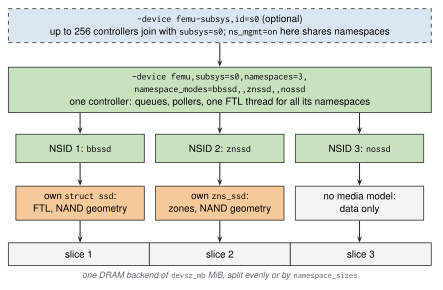
Figure: One controller with three namespaces of different modes: each BBSSD or ZNS namespace builds its own FTL and NAND model, and all of them share slices of one DRAM backend. Sharing a namespace between controllers is limited to NoSSD or BBSSD without namespace_modes.
 femu-subsys device id=S [ns_mgmt=on] [fdp=on]     optional; not on any bus
   |  CNTLID table (up to 256), SUBNQN, endurance group (FDP),
   |  shared storage object (ns_mgmt=on only)
   |
   +-- femu device, subsys=S       controller CNTLID 0   (PCIe endpoint)
   |      queues, pollers, one FTL thread
   |      namespace table: 256 slots, NSID = slot + 1
   |        NSID 1  mode A  -> backend bytes [0, size1)
   |        NSID 2  mode B  -> backend bytes [size1, size1 + size2)
   |        ...
   |      DRAM backend (devsz_mb)
   |
   +-- femu device, subsys=S       controller CNTLID 1
          its own namespaces and backend, unless the subsystem has ns_mgmt=on

 femu device, no subsys=          a controller without a subsystem: the same,
                                    with CNTLID 0 and no subsystem features
There is no namespace -device. Namespaces live inside the controller (or
the subsystem's storage object) and are built from controller properties.
femu-subsys creates an nvme-bus, but no FEMU device plugs into it.
Data structures
| Structure | File | Fields that matter |
|---|---|---|
NvmeSubsystem | nvme.h | ctrls[256] (CNTLID slots), subnqn, endgrp (FDP), ns_mgmt, storage (the shared storage object), ns_lock |
FemuCtrl | nvme.h | namespaces (256 slots), num_namespaces (boot count), namespace_limit (slots in use: the boot count, or 256 with Namespace Management), namespace_pool_size, mbe (DRAM backend), attached_ns (per-controller attachment bitmap for shared namespaces), cntlid, ext_ops (the controller's mode table) |
NvmeNamespace | nvme.h | id, size (bytes the host sees), extent_size (bytes reserved in the backend), backend_offset, start_block, femu_mode, csi, ext_ops (this namespace's mode table), allocated, attached, util and uncorrectable bitmaps, mdata, the mode state (ssd for bbssd and CSD, zns for ZNS), endgrp and fdp |
Namespace sizes and backend partitioning
Every controller has one DRAM backend of devsz_mb MiB, created in
femu_realize(). For bbssd with op_pcent the backend is the full NAND
capacity of the geometry instead, and the exposed capacity is that NAND
capacity divided by 1 + op_pcent / 100, so the spare space is op_pcent
percent of the exposed size (op_pcent=25 exposes 80 % of the NAND).
nvme_resolve_ns_sizes() then sizes the boot namespaces:
namespace_sizesunset: the exposed capacity is split evenly, each share rounded down to 512 bytes.namespace_sizesset: one size per namespace, each at least one 512-byte sector; the sum must fit in the exposed capacity (devsz_mb, or the over-provisioned NAND capacity withop_pcent), all of it, whatever the namespace count.
Either way each size is then rounded down to whole logical blocks of the
format lba_index selects (512 << lba_index bytes), so no slice ends in
part of a block the host cannot address and every slice starts on a block
boundary. A KV namespace is sized in bytes and is rounded to 512 bytes only.
A size smaller than one logical block leaves an empty namespace.
nvme_init_namespaces() packs the slices in NSID order. Each namespace
records where its slice starts in backend_offset, and every data path
adds it to the byte offset of an LBA, so no namespace can reach another's
data:
 devsz_mb=4096, namespaces=4, namespace_modes=nossd,,bbssd,,znssd,,kvssd

 backend  0        1 GiB      2 GiB      3 GiB      4 GiB
          +----------+----------+----------+----------+
          | NSID 1   | NSID 2   | NSID 3   | NSID 4   |
          | nossd    | bbssd    | znssd    | kvssd    |
          +----------+----------+----------+----------+
 backend_offset: 0    1 GiB      2 GiB      3 GiB

 byte of LBA x in NSID n = backend_offset(n) + x * logical block size
The namespace's NSZE, NCAP and NUSE start as its slice size divided by the logical block size of its format. A zoned namespace then lowers NSZE to its whole zones (see ZNS); a KV namespace measures its capacity in bytes.
The pool reported to the host is the sum of the boot slices: TNVMCAP is the pool size and UNVMCAP the part no namespace holds. Backend space past the last boot slice, including what the rounding above leaves, is not in the pool and no namespace uses it.
Per-namespace modes
namespace_modes gives each namespace its own mode, from the tokens
nossd, bbssd, znssd, ocssd, csd and kvssd. Unset, every
namespace runs femu_mode. nvme_resolve_ns_modes() parses the list.
 femu_realize()
   nvme_init_namespaces()        sizes, slices, modes, per-namespace checks
   nvme_register_extensions()    controller ext_ops = table of femu_mode
                                 (used by the admin paths)
   for each namespace:
     nvme_register_extensions_ns()   ns->ext_ops = table of the ns's mode
     ns->ext_ops.init(n, ns)         bb_init, zns_init, kvssd_init, ...
   start one FTL thread if any namespace is bbssd, ZNS or CSD
At run time the mode is chosen per command, not per controller:
- I/O commands that the common path in
nvme-io.cdoes not handle itself go tons->ext_ops.io_cmdof the namespace the command names. - The controller's single FTL thread routes each request by
req->ns: ZNS namespaces tozns_ftl_process_req(), bbssd and CSD namespaces tobb_ftl_process_req(); NoSSD and KV cost nothing there. - Each namespace reports its own command set (CSI 2 for ZNS, 1 for KV, 0 otherwise). The controller always advertises NVM, Zoned and KV in its I/O Command Set list; only the Changed Zone List entry in the supported log pages depends on a zoned namespace being present.
The controller's model number and serial come from its own femu_mode.
Every namespace still advances its mode's serial counter as it starts, so
serials keep their values, but only a namespace of the controller's mode
names the controller. When none does (a KV controller whose KV namespace is
not namespace 1, for example), the controller is named from femu_mode once
its namespaces are up (nvme_set_ctrl_name()).
Each namespace keeps its own mode state. Every bbssd or CSD namespace has a
complete FTL with the full NAND geometry, and must fit in that geometry on
its own with room for GC. Every ZNS namespace builds its own zones from the
shared zns_ properties and its own size. Every KV namespace has its own
key space.
| Rule | Why | Where |
|---|---|---|
ocssd only as the controller's own mode, and only with one namespace | Open-Channel tables are controller-wide | nvme_init_namespaces() |
at most one csd namespace per controller | CSD keeps controller-wide state | nvme_init_namespaces() |
no kvssd with FDP | placement takes every line, leaving the KV store none | nvme_init_namespaces() |
meta and streams need every namespace to be nossd or bbssd | only the block data path carries them | nvme_init_namespaces() |
| one namespace with FDP | the FDP write path addresses the FTL by command LBA, not slice | nvme_init_namespaces() |
Namespace management
With ns_mgmt=on on a controller, and when the controller and every boot
namespace run the same mode, NoSSD or bbssd, with no dps and no FDP
(nvme_ns_mgmt_supported()), the controller:
- reports NN = 256 and opens all 256 slots (
namespace_limit); - sets OACS bit 3 (Namespace Management) and OAES Namespace Attribute notices;
- reports each namespace's NVMCAP.
In any other configuration ns_mgmt=on adds no Namespace Management.
Realize refuses it outright with a subsystem that lacks ns_mgmt, and with
power_loss or cxl_ssd.
Create, attach, detach, delete
 pool = sum of boot slices          (all of it in use at boot)

   | NSID 1 (2 GiB)        | NSID 2 (2 GiB)        |     Delete NSID 2
   | NSID 1 (2 GiB)        |      free 2 GiB       |     Create 1 GiB
   | NSID 1 (2 GiB)        | NSID 2 (1 GiB) | free |     detached until Attach

 create: lowest free NSID; extent = first gap that fits (first fit)
Namespace Management Create (nvme_ns_mgmt() in nvme-admin.c, then
nvme_ns_create() in femu.c):
- accepts only the NVM command set, with NCAP equal to NSZE (a smaller NCAP
fails with Thin Provisioning Not Supported), an LBA format the controller
offers, and a PI setting only if
pi=on; - rounds the size up to a NAND page for bbssd (
secs_per_pg * secsz) and to 4 KiB for NoSSD; - takes the lowest free NSID and the first gap in the pool that fits
(
nvme_ns_find_extent()); no gap fails with Namespace Insufficient Capacity; - for bbssd, refuses a new namespace once
bbssd_ns_limitnamespaces are allocated, and refuses one that would leave its FTL no room for GC; - zeroes the slice, builds the mode state, and leaves the namespace detached.
The controller pauses its pollers and FTL thread around create and delete,
so no request runs against a half-built or half-freed namespace. Attach and
detach flip attached (or a bit of attached_ns for shared namespaces)
and send Attached Namespace Attribute Changed notices to the controllers
they affect. Delete releases the slice; the gap is reused by the next
create.
Subsystems and shared namespaces
A controller joins a subsystem with subsys=<id>; the subsystem must come
first on the command line. nvme_init_subsys() gives it the lowest free
CNTLID. What else is shared depends on the subsystem's properties:
| Subsystem | Controllers | What they share |
|---|---|---|
| plain | any number | only the CNTLID space; each keeps its own namespaces and backend, and none can use Namespace Management, so the controller lists (CNS 12h, 13h) are not available |
fdp=on | one | the endurance group and its FDP state (FDP) |
ns_mgmt=on | any number, NoSSD or bbssd, all alike | one namespace table, backend and set of FTLs, and the SUBNQN |
A controller with streams=on also cannot share a subsystem.
Shared namespaces
 femu-subsys,ns_mgmt=on
   storage object (an unrealized femu, a copy of the first controller's
   properties): namespace table, DRAM backend, one FTL per bbssd namespace
       ^                      ^                       ^
       | attached_ns bitmap   | attached_ns bitmap    |
   controller A (CNTLID 0)  controller B (CNTLID 1)   ...
   own queues, pollers, FTL thread (bbssd only), namespace-change log
   all I/O decode and FTL work of every controller under subsys->ns_lock
- The subsystem must be realized before its controllers. The first
controller builds the boot namespaces;
nvme_subsys_take_storage()then moves them, with the backend, to a storage object that copies the first controller's properties. That controller starts with every boot namespace attached; later controllers start with none. - Later controllers must match the first in mode,
meta,pi,mc,dpc,nlbaf,vwcandoncs. Their own capacity and geometry properties do not create storage. - Identify Controller reports CMIC bit 1 (multiple controllers) and the subsystem's NQN; each namespace reports NMIC from its creation, and a private namespace cannot be attached to two controllers at once.
subsys->ns_lockserializes command decode on the pollers and request processing on the FTL threads of all controllers, so two controllers never run the same FTL at once.- The namespaces and backend outlive any one controller. They are released when the subsystem is removed and its last controller has left.
femu-subsys with both ns_mgmt=on and fdp=on is refused.
Metadata and protection information
 Identify Namespace LBA formats with meta=8, nlbaf=5:
   index 0..4   512 B, 1 KiB, 2 KiB, 4 KiB, 8 KiB      no metadata
   index 5..9   the same sizes                          8 bytes metadata
   boot format = nlbaf + lba_index (5 with lba_index=0)

 where the bytes live:
   data      DRAM backend, at backend_offset + LBA * block size
   metadata  ns->mdata, a separate host buffer of (blocks * meta) bytes,
             one entry per LBA, under ns->mdata_lock
   transfer  separate buffer (MPTR, mc bit 1), or interleaved after each
             block in the data buffer (extended LBA, mc bit 0)
metasets the metadata bytes per block and doubles the format list.nlbafis then at most 8.- With
pi=onandmetaof 8 or more, Identify reports DPC 1Fh: PI types 1 to 3, in the first or last 8 bytes of the metadata. The host picks a type with Format NVM or at Namespace Management create. FEMU generates the PI when PRACT is set and checks the guard (CRC-16 T10-DIF), application tag and reference tag as the PRCHK bits ask (nvme-pi.c). dpcanddpsdescribe PI without these paths. A non-zerodpscannot pass the realize checks, so usepi.- Metadata and PI work only on NoSSD and bbssd namespaces and not with FDP.
Threads and locks
| Lock | Protects | Taken by |
|---|---|---|
subsys->ns_lock | the shared namespace table and FTLs (shared namespaces only) | pollers around command decode, FTL threads around each request |
ns->mdata_lock | the metadata buffer of one namespace | every metadata read and write |
poller pause (nvme_pause_pollers()) | namespace lifecycle, Format, Sanitize | admin path; pauses every controller of a shared subsystem |
Parameters
Properties are in the property reference under mode, capacity and namespaces, namespace management, streams and power loss, LBA formats, metadata and protection and shared namespaces.
| Property | On | Effect and interactions |
|---|---|---|
devsz_mb | femu | Backend size, split between the boot namespaces. |
namespaces | femu | Boot namespaces, 1 to 256. |
namespace_sizes | femu | Per-namespace sizes; commas doubled on the QEMU command line. |
namespace_modes | femu | Per-namespace modes; see the rules above. Refused with a shared subsystem. |
op_pcent | femu | bbssd: backend = NAND capacity; exposed capacity = NAND capacity / (1 + op_pcent / 100). |
ns_mgmt | femu, femu-subsys | Namespace Management; on the subsystem, shared namespaces. A controller with it cannot join a subsystem without it. |
bbssd_ns_limit | femu | bbssd namespaces allocated at once, 1 to 256 and at least namespaces. Each has a full FTL in host memory. |
subsys | femu | Joins a femu-subsys. |
nqn | femu-subsys | SUBNQN suffix; reaches Identify only on a shared subsystem. |
meta, mc, extended, pi, nlbaf, lba_index, dpc, dps | femu | Formats, metadata and PI, above. |
A NoSSD namespace and a ZNS namespace of different sizes on one controller:
-device femu,devsz_mb=2048,femu_mode=2,namespaces=2,namespace_sizes=1G,,1G,namespace_modes=nossd,,znssd
Statistics and outputs
| Output | Scope |
|---|---|
| Identify Controller TNVMCAP, UNVMCAP | the controller's namespace pool |
| Identify Namespace NSZE, NCAP, NUSE, NVMCAP | one namespace (NVMCAP with Namespace Management) |
| Namespace lists (CNS 02h, 10h), controller lists (CNS 12h, 13h) | 12h and 13h answer only with Namespace Management; 02h and 10h on any controller |
| Changed Namespace List (04h) | namespaces attached, detached, deleted or reformatted, per controller; filled only with Namespace Management |
| SMART / Health (02h) | the controller, summed over its namespaces |
| Vendor log C0h | summed over the bbssd, CSD and KV namespaces (log pages and counters) |
Validation
qtest cases in hw/femu/tests/qtest/femu-test.c:
- layout and modes:
namespace-capacity,namespace-identity,namespace-mixed-identityand its-bbssdand-kvvariants,namespace-sizes-rounding,namespace-large,namespace-empty-slice,namespace-kv-byte-capacity,kv-namespaces,namespace-sparse; - management: the
ns-mgmt-*cases (lifecycle, capacity,bbssd_ns_limit, notices, validation, unsupported modes and FDP),namespace-lifecycle,namespace-allocated,ns-retire-*; - shared namespaces: the
ns-shared-*cases andns-mgmt-subsys; - metadata and PI:
metadata,metadata-bbssd,metadata-extended, and thepi-*cases.
Every tagged documentation example with several namespaces or controllers is also started under qtest and moves one block on namespace 1.
Limits
- Namespace Management creates only NoSSD or bbssd namespaces of the controller's own mode, and only on controllers whose namespaces all run that mode. It does not create zoned, KV, CSD or Open-Channel namespaces.
- Each bbssd namespace has a full-size FTL; there is no scaled geometry for
small namespaces, which is why
bbssd_ns_limitexists. - Allocated Namespace Attribute notices are not advertised.
- Shared namespaces need homogeneous NoSSD or bbssd controllers without
Streams,
dpsornamespace_modes. - All namespaces and metadata live in host memory and are lost when QEMU exits.
How to extend it
- A new mode token: add it to
nvme_mode_from_token(), register its table innvme_register_extensions(), add any per-namespace restriction tonvme_init_namespaces(), and keephw/femu/docs/modes.pyin step. - A mode that keeps controller-wide state must refuse a second namespace of that mode, as CSD does, or move the state into the namespace.
- Namespace Management for another mode:
nvme_ns_mgmt_supported(),nvme_ns_create()and the capacity checks innvme_ns_mgmt()are the places that limit it to NoSSD and bbssd. - Any new data path must add
ns->backend_offsetto its byte offsets.
Source map
| File | What is there |
|---|---|
hw/femu/femu.c | femu-subsys device, CNTLID registration, namespace sizing, packing and per-namespace mode setup (nvme_init_namespaces()), nvme_ns_create(), extent search, shared storage (nvme_subsys_take_storage()), capacity reporting |
hw/femu/nvme.h | NvmeSubsystem, NvmeNamespace, nvme_ns() and attachment helpers |
hw/femu/nvme-admin.c | Namespace Management and Attachment, Identify lists, Format NVM |
hw/femu/nvme-io.c | per-namespace dispatch, backend offsets, metadata transfer |
hw/femu/nvme-pi.c, hw/femu/nvme-pi.h | protection information generation and checks |