The BlackBox FTL
This page is hw/femu/docs/design/ftl.md at FEMU 39a55eeb6 (2026-10-02), licensed GPL-2.0-or-later. Send corrections to the FEMU repository.
This chapter describes the flash translation layer (FTL) behind BlackBox mode
(femu_mode=1): how it maps logical pages to NAND pages, how it organises
NAND into lines and write pointers, how it collects garbage, and how its
write buffer, read cache, wear and refresh models work. It is written for
readers who want to know what the model does, where its time goes, and how
to change it. To run the mode, read the BlackBox guide
first; this chapter does not repeat its launch and guest steps.
The code lives in hw/femu/bbssd/. The same FTL serves CSD namespaces, which
build it through the same ssd_init(). KV namespaces call ssd_init() for
the geometry and NAND timing but run their own key-value FTL. A
femu-cxl-ssd builds a private instance on its own worker thread.
NAND operation timing (per-LUN timelines, the channel bus, suspend, ECC tiers) is the subject of the NAND timing chapter in this directory, and of the timing model. This chapter covers what the FTL asks of the NAND, not how long each operation takes.
Place in the hierarchy
  guest NVMe driver
        |  SQ doorbell
        v
  +---------------------------+   copies the payload between guest memory
  | femu-poller thread(s)     |   and the host memory backend, then hands
  |  nvme_rw(), nvme_dsm(),...|   every I/O request to the FTL ring
  +---------------------------+
        |  to_ftl[i]                       ^ to_poller[i]
        v                                  |
  +---------------------------------------------------------------+
  | FEMU-FTL-Thread: femu_ftl_thread() -> bb_ftl_process_req()    |
  |                                                               |
  |   +-------------+  +--------------+  +----------------------+ |
  |   | mapping     |  | write buffer |  | read cache           | |
  |   | page, dftl, |  | (LPNs, LRU)  |  | (LPNs, timing only)  | |
  |   | hybrid,fast |  +--------------+  +----------------------+ |
  |   +-------------+                                             |
  |   +---------------------------------------------------------+ |
  |   | line management, write pointers, GC, read reclaim       | |
  |   +---------------------------------------------------------+ |
  +---------------------------------------------------------------+
        |  ssd_advance_status(): one read, program or erase
        v
  +---------------------------------------------------------------+
  | NAND media layer (hw/femu/nand/nand-media.c)                  |
  |   per-LUN next-available times, optional channel bus          |
  +---------------------------------------------------------------+
Two things follow from this picture.
- The FTL models time and placement, not data. The poller copies the
payload to the host memory backend before the request reaches the FTL. The
FTL tracks which NAND page each logical page would occupy and how long each
operation takes, but it never stores the payload. The one exception is the
power-loss model (
power_loss=on), which runs the data copy on the FTL thread and keeps undo copies of buffered pages; see Power loss. - The FTL returns a duration. Each handler returns the time the request
spends in the device, measured from the request's arrival time
stime. The FTL thread adds it toreq->expire_time, and the poller completes the request when the host clock reaches that time.
The FTL thread and its queues
   poller 1                   FEMU-FTL-Thread                  poller 1
  +---------+  to_ftl[1]   +-------------------------+ to_poller[1] +-----------+
  | SQ scan |------------->|                         |------------->| pq[1]     |
  +---------+   (rte_ring) |  for i in 1..nr_pollers |              | ordered by|
   poller 2                |    dequeue one request  |              | expire_   |
  +---------+  to_ftl[2]   |    lat = femu_ftl_      |  to_poller[2]| time; CQE |
  | SQ scan |------------->|      process_req(req)   |------------->| posted    |
  +---------+              |    expire_time += lat   |              | when now  |
      ...                  |    enqueue to_poller[i] |              | >= expire |
                           +-------------------------+              +-----------+
                                       |
                                       | after every request:
                                       v
                           background GC check (one victim)
- One thread per controller.
femu_ftl_thread()inhw/femu/femu.cstarts at realize when a namespace is bbssd, ZNS or CSD (or the controller shares a bbssd subsystem), after every namespace is built. It is joined at device removal. - One pair of rings per poller. Each poller
ifeedsto_ftl[i]and readsto_poller[i]. The FTL thread visits the rings in turn and takes one request from each non-empty ring per pass, so no poller can starve another. - Every I/O command goes through the ring, including Flush, Dataset
Management and commands that already failed in the I/O layer. A failed
request is not processed:
bb_ftl_process_req()returns 0 for it, and the poller posts the carried error status. - No lock protects the FTL state. The FTL thread is the only writer of
the mapping, the lines, the write buffer and the caches. With Streams on,
each request runs under
n->streams_lock; on a shared subsystem namespace it runs under the subsystem'sns_lock. An NVMe controller linked to afemu-cxl-ssdruns its requests on its own FTL thread against the medium's FTL, under the medium's lock, which also serializes the medium's worker. - Admin commands that change FTL state pause the dataplane.
nvme_pause_pollers()waits until the FTL thread is outside a request (theftl_in_sweepflag), so the run-time switch (admin opcode 0xEF), the volatile write cache feature, Format and Sanitize change FTL state with nothing in flight.
bb_ftl_process_req() in hw/femu/bbssd/ftl.c dispatches on the opcode:
| Opcode | Handler | What the FTL does |
|---|---|---|
| Read | ssd_read() | translate each page; buffer hit, read cache hit or NAND read |
| Write | ssd_write() | foreground GC, read reclaim, then buffer or program each page |
| Write Zeroes | ssd_write_zeroes() | with the Deallocate bit: unmap; without it: program the range |
| Dataset Management | ssd_trim() | deallocate each range |
| Copy | ssd_copy() | read every source range, then write the destination |
| Flush | ssd_buffer_destage(ssd, 0, ...) | program everything the write buffer holds |
| I/O Management Send | ssd_fdp_update_ruhs() | FDP only: update reclaim unit handles |
Read and Write latency is the largest per-page latency of the request: pages on different LUNs proceed in parallel, and pages on one LUN queue on its timeline. Copy costs the slowest source read plus the destination write. After the opcode handler, the thread runs one background GC step if the device is past the background watermark (Triggers).
Data structures
All of the FTL's state hangs off struct ssd (hw/femu/bbssd/ftl.h), one
per bbssd or CSD namespace.
Physical page address
A struct ppa packs a NAND location into 64 bits:
 63  62          51 50      44 43  40 39      32 31            16 15             0
+---+--------------+----------+------+----------+----------------+----------------+
|rsv|  ch (12)     | lun (7)  |pl (4)| sec (8)  |   pg (16)      |   blk (16)     |
+---+--------------+----------+------+----------+----------------+----------------+
The field widths bound the geometry: at most 4096 channels, 128 LUNs per
channel, 16 planes per LUN, 65536 blocks per plane, 65536 pages per block and
256 sectors per page. bb_check_geometry() refuses larger values, and also
refuses a geometry whose total sector count exceeds INT_MAX, because the
derived totals in struct ssdparams are int. The FTL always addresses
whole pages; the sec field is unused by the mapping.
NAND state
ssd->ch[nchs]
  .next_ch_avail_time
  .lun[luns_per_ch]
     .next_lun_avail_time          <- the timeline every NAND op is gated on
     .pl[pls_per_lun]
        .blk[blks_per_pl]
           .vpc, .ipc              valid and invalid page counts
           .erase_cnt              P/E cycles of this block
           .read_cnt               reads since the last erase
           .pg[pgs_per_blk].status FREE, VALID or INVALID
A page goes FREE -> VALID when it is programmed (mark_page_valid()),
VALID -> INVALID when its logical page is overwritten, deallocated or moved
by a log-block merge (mark_page_invalid()), and back to FREE when its block
is erased (mark_block_free()). A page that line GC relocates stays VALID
until its block is erased. Closing a stream's line marks its unwritten pages
INVALID directly.
Mapping tables
 maptbl: logical page -> physical page        rmap: physical page -> logical page
 (one struct ppa per logical page)            (indexed by ppa2pgidx(), one u64 each)

  LPN    PPA                                   pgidx                     LPN
 +-----+--------------------------+           +------------------------+-----+
 |  0  | ch0 lun0 pl0 blk7 pg3    |---------->| ch0 lun0 pl0 blk7 pg3  |  0  |
 |  1  | UNMAPPED                 |           | ch1 lun0 pl0 blk7 pg3  |  5  |
 |  2  | ch3 lun1 pl0 blk2 pg0    |           | ...                    | ... |
 | ... | ...                      |           | (stale copy)           | INV |
 +-----+--------------------------+           +------------------------+-----+
maptbl is the forward map and rmap the reverse map that GC uses to find
which logical page a valid physical page holds. Both have one entry per NAND
page (tt_pgs), 8 bytes each: 32 MiB apiece for the default 16 GiB geometry.
Every mapping scheme keeps these two tables as the source of truth.
Lines
typedef struct line {
    int id;              /* the block index this line spans */
    int ipc, vpc;        /* invalid and valid pages over the whole line */
    size_t pos;          /* slot in the victim priority queue, 0 if none */
    uint64_t close_time; /* when the line filled; age-based policies */
    uint64_t stream_tag; /* Streams: the stream whose data it holds */
    bool reclaiming;     /* being rewritten by read reclaim */
    ...
} line;
struct line_mgmt keeps a free list (a FIFO), a victim priority queue keyed
by valid page count, and a full list.
Address mapping
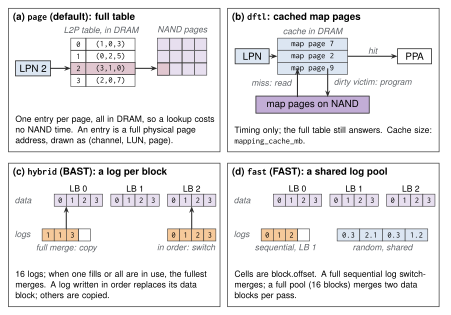
Figure: The four BBSSD mapping schemes (mapping=): the full page table, DFTL's cache of map pages, BAST's log block per data block, and FAST's shared log pool.
From LBA to logical page
ssd_lpn_range() turns an LBA range into a range of logical page numbers
(LPNs). A page is secsz * secs_per_pg bytes. The byte offset is the LBA
times the LBA size, plus the namespace's offset in the backend:
LPN = (backend_offset + slba * lba_size) / page_size
So a namespace's LPNs start where its data starts in the backend. A
controller with Namespace Management on uses offset 0, because each managed
namespace has a private FTL. A request whose last LPN is at or beyond
tt_pgs fails with LBA Out of Range.
Page mapping (mapping=page)
The default. translate() returns maptbl[lpn]. A write invalidates the old
physical page, if any, and points the LPN at the new one. A read of an LPN
with no mapping costs no NAND time.
DFTL (mapping=dftl)
DFTL keeps the page-level mapping on NAND and caches the translation pages
that are in use. FEMU models the cost of that cache, not its contents: the
flat maptbl stays the source of truth, and cmt_touch() in
hw/femu/bbssd/ftl-map-cmt.c charges NAND time for misses.
  host read/write of lpn
        |
        v
  tp_id = lpn / lpn_per_tp          lpn_per_tp = page_size / 8
        |                           (512 for a 4 KiB page)
        v
  +-------------------------------+
  | cached mapping table (CMT)    |  capacity = mapping_cache_mb / page_size
  | CLOCK, one slot per TP        |  slots
  +-------------------------------+
     | hit: no cost; a write marks the slot dirty
     | miss:
     v
  evict a slot by CLOCK
     | dirty victim: program it on LUN (victim tp_id % tt_luns)
     v
  read the TP on LUN (tp_id % tt_luns), after the write-back
     |
     v
  latency = write-back + read, charged to this request
With mapping_cache_mb left at 0, DFTL uses 4 MiB, which holds 1024
translation pages and so covers 2 GiB of logical space on a 4 KiB page. The
translation-page traffic occupies the LUN timelines like any other NAND
operation but is not counted as host or GC writes. Host reads, host writes and
buffer write-backs are charged; GC relocation, deallocate, Write Zeroes and
the FDP write path update maptbl without a CMT access.
Log-block mapping: BAST (mapping=hybrid) and FAST (mapping=fast)
The two log-block schemes write every page through a separate LOG write
pointer and model the merges a log-block FTL has to run. Like DFTL, they use
maptbl for correctness, so a read always finds the newest copy. A logical
block (LBN) is pgs_per_blk consecutive LPNs.
 hybrid (BAST): one log per logical block      fast (FAST): one sequential log
                                               plus a shared random-write pool
  pool of 16 logs                               SW log: one LBN, in-order run
 +--------+--------+-----+--------+            +--------------------------+
 | LBN 12 | LBN 40 | ... | free   |            | LBN 7: off 0,1,2,...     |
 | used 9 | used 256      |        |            +--------------------------+
 +--------+--------+-----+--------+            RW pool: 16 blocks of pages,
      |        |                               any LBN, dirty LBN list
      |        +-- full: merge                 +--------------------------+
      |                                        | LBN 3, LBN 90, LBN 12... |
      +-- pool exhausted: merge the fullest    +--------------------------+
                                                     | pool full: merge two
  merge:                                             | dirty LBNs per pass
   written in order (offset i at slot i)?            v
     yes -> switch merge: erase the old       random merge: relocate each
            data block, no copies             live page of those LBNs
     no  -> full merge: relocate each live    SW log full in order:
            page of the LBN to DATA space     switch merge, one erase
- hybrid follows BAST (Kim et al. 2002): one log per logical block, from a pool of 16. Each program consumes a log slot, overwritten or not; neither an overwrite nor a deallocate frees a slot, only a merge does. After every programmed page, if a log is full or every log in the pool is taken, the fullest log is merged. A log written strictly in order switch-merges for the cost of one erase. Any other log full-merges: every live page of its LBN is read and programmed into DATA-class space, counted as GC writes. Hybrid counts its merges for log page C0h. The scheme models merge cost, not BAST's physical block placement: logs of different LBNs share physical lines, and line GC still runs underneath and can add copies.
- fast follows FAST (Lee et al. 2007): a single sequential-write log for an in-order run that starts at offset 0 of an LBN, and a shared pool of 16 blocks' worth of pages for everything else. When the pool fills (or the dirty-LBN list reaches its 4095 limit), a reclaim relocates the live pages of up to two dirty LBNs, and repeats on later writes until the pool is no longer full. A full in-order sequential log switch-merges with one erase. The sequential log is released only when it fills in order; a broken run keeps holding it, and later sequential runs go to the shared pool. FAST reclaims once per request, not once per page, and its merge counts are not exported.
Merge reads, programs and erases are charged to the request that triggered the merge, and the relocated pages count in the write amplification factor.
Choosing a scheme
mapping | Models | Extra cost charged | Extra write pointer | Counters |
|---|---|---|---|---|
page | a full page map in DRAM | none | none | none |
dftl | a page map on NAND with a cache of translation pages | translation page read on a miss, program on a dirty eviction | none | none exported |
hybrid | BAST log blocks | switch and full merges per log | LOG | C0h bytes 88 to 111 |
fast | FAST log blocks | bounded random merges, sequential switch merges | LOG | none exported |
Streams need page or dftl. FDP supports only page.
Lines, superblocks and write pointers
A line is a superblock
A line is the block with the same index on every plane of every LUN of every
channel. There are blks_per_pl lines, each nchs * luns_per_ch * pls_per_lun blocks wide. A write pointer fills a line in this order:
channel first, then LUN, then plane, then page.
            ch0     ch1     ch2   ...  ch7
  lun0  pg0 [ 0 ]   [ 1 ]   [ 2 ]       [ 7 ]     numbers are the order in
  lun1  pg0 [ 8 ]   [ 9 ]   [10 ]       [15 ]     which the write pointer
  ...                                             hands out pages of line N
  lun7  pg0 [56 ]   [57 ]   [58 ]       [63 ]     (one plane per LUN)
  lun0  pg1 [64 ]   [65 ]   ...
  ...
  lun7  pg255                          [16383]   -> line full, take the next
                                                    free line
Consecutive pages land on different channels, then different LUNs, so a large write or a burst of small ones spreads over the whole device. With several planes, the pointer sweeps every channel and LUN on plane 0, then on plane 1, and so on, before the page index moves on.
Why there are several write pointers
Each write pointer holds one line open and appends to it. Data written through one pointer shares lines, so the lines die together or not. Keeping data of different lifetimes apart is what makes GC victims mostly invalid. The FTL has these pointers:
| Pointer | In struct ssd | Takes | Opened |
|---|---|---|---|
| data | wp | host writes (only first writes with hot_cold_sep=on), GC relocations, read reclaim, merge relocations | at init |
| hot | hot_wp | overwrites of mapped pages, with hot_cold_sep=on | on first use |
| log | log_wp | every host write under hybrid or fast | on first use |
| stream | stream_wp[i] | writes of open stream i | on first use |
| stream GC | stream_gc_wp | relocated pages of a released stream | on first use |
| reclaim unit | per handle | FDP placement; see FDP | FDP init |
When a hot or log pointer cannot get a line, the write falls back to the
data pointer. Every open pointer pins a line, so bb_check_capacity() adds
one reserved line per pointer the configuration can hold open
(Capacity).
Hot/cold separation
With hot_cold_sep=on and page or DFTL mapping, prepare_write() sends a
write to the hot pointer when its LPN is already mapped. An overwrite is the
cheapest predictor of another overwrite, so hot lines fill with pages that
are invalidated together. GC relocations go through the data pointer, so
pages that survive a collection join the cold data. The log-block schemes
ignore the setting, but the extra reserved line is still counted. FDP
refuses it.
Line state machine
                 +-------------------------------------------------+
                 |                                                 |
                 v                                                 |
            +---------+  a write pointer takes it  +----------+    |
  init ---->|  FREE   |--------------------------->|   OPEN   |    |
            | (FIFO)  |                            | (curline)|    |
            +---------+                            +----------+    |
                 ^                                   |       |     |
                 |                    last page      |       |     |
                 |                    programmed,    |       |     |
                 |                    all valid      |       |     |
                 |                                   v       |     |
                 |                             +--------+    |     |
                 |                             |  FULL  |    | last page programmed,
                 |                             | (list) |    | some invalid
                 |                             +--------+    |     |
                 |          first invalidation     |         |     |
                 |                                 v         v     |
                 |                             +----------------+  |
                 |                             |    VICTIM      |  |
                 |                             | priority queue |  |
                 |                             | keyed by vpc   |  |
                 |                             +----------------+  |
                 |        selected by gc_policy   |                |
                 |                                v                |
                 |                         +-------------+         |
                 +-------------------------| COLLECTING  |         |
                   relocate valid pages,   | in no list  |         |
                   erase every block       +-------------+         |
                                                                   |
   read reclaim: FULL or VICTIM -> COLLECTING (reclaiming=true) ---+
   Streams: a released stream's partly written OPEN line has its
   free pages marked invalid and joins VICTIM (or FREE if empty)
An open line belongs to no list; invalidations only lower its valid count.
When a line fills, close_time is set. The free list is a FIFO: lines are
taken from the head and returned to the tail. The FTL has no explicit wear
levelling; the FIFO spreads erases over the free lines.
Garbage collection
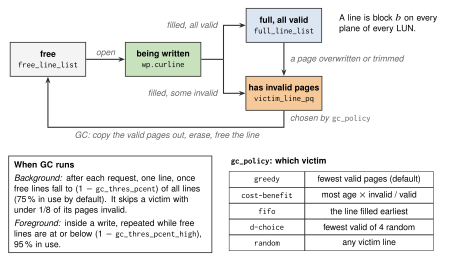
Figure: BBSSD line states and garbage collection: when a line moves between the free, written, full and victim sets, when background and foreground GC run, and how each gc_policy picks a victim.
The code is in hw/femu/bbssd/ftl-line-gc.c.
Triggers and watermarks
The two watermarks are stored as free-line counts:
  gc_thres_lines      = (int)((1 - gc_thres_pcent/100)      * tt_lines)
  gc_thres_lines_high = (int)((1 - gc_thres_pcent_high/100) * tt_lines),
                        at least 1 with hot_cold_sep, Streams, or a hybrid
                        or fast mapping (bb_gc_forced_lines())
The floor matters below 20 lines, where the default high watermark rounds to zero. A second write pointer can then take the last free line while the data pointer, which GC writes into, is nearly full, and GC would have nowhere to put a victim's pages (with Streams, GC refuses such a victim outright). One free line always holds a whole victim. The floor costs those small geometries one line of exposable capacity.
| Kind | When | Where | Victim filter | How many |
|---|---|---|---|---|
| Background | free lines <= gc_thres_lines | after every request that reaches the FTL without an error, any opcode | the chosen line must have at least 1/8 of its pages invalid | one line |
| Foreground (forced) | free lines <= gc_thres_lines_high | at the start of a write, and before every page that a write, a write-back of the buffer, or Write Zeroes without Deallocate programs | none | repeats until above the watermark or no victim |
Forced GC runs per page, not once per command: one command can program more lines than the watermark keeps free, and a collection that starts after the last line is gone has nowhere to move pages to.
A GC step returns -1 when there is no victim, when the background filter rejects it, or when the victim's valid pages cannot all be moved; the forced loop then stops. With Streams on, a step also fails when it frees nothing, because lines of distinct retired streams cannot be combined, or when the victim holds valid pages and no line is free.
Victim policies
gc_policy selects one entry of femu_ftl_policies[]:
gc_policy | Chooses | Cost per choice |
|---|---|---|
greedy | the line with the fewest valid pages: the top of the priority queue | O(log n) |
random | a uniformly random line of the queue (rand()); a background step puts it back if it fails the 1/8 filter | O(log n) |
cost-benefit | the largest age x (1 - u) / 2u, with u = vpc / pgs_per_line and age = now - close_time, compared in 128-bit integers; a line with no valid pages always wins | O(n) scan |
fifo | the line with the oldest close_time, whatever its valid count | O(n) scan |
d-choice | the fewest valid pages among 4 queue slots picked from the host clock; a slot can be picked twice | O(1) sample |
Only lines in the victim queue are candidates. A line that closed with every
page valid stays in the full list until something invalidates one of its
pages. d-choice samples by the host clock, so its picks differ between runs.
random uses the process-wide, unseeded rand() stream, so it repeats only
when the order of collections, and of other rand() users, repeats.
Collecting a line
  do_gc(force)
    |
    v
  victim = policy->select_victim_line(force)  -- none? return -1
    |
    v
  move: for ch, lun, pl, each page of block (ch, lun, pl, victim->id):
    if VALID:
      new = next page of the data pointer        (stream pointer for
            (takes a free line if it has none)    Streams data)
      none? requeue the victim, return -1
      NAND read at the old page                  (GC_IO)
      lpn = rmap[old]
      maptbl[lpn] = new, rmap[new] = lpn
      old page -> INVALID, rmap[old] = none
      NAND program at the new page               (GC_IO)
      gc_write_pages++
    |
    v
  erase: for ch in 0..nchs-1, lun in 0..luns_per_ch-1:
    mark each plane's block free: erase_cnt++, read_cnt = 0
    one multi-plane erase of the LUN's blocks    (GC_IO, tplebsy between
                                                  planes)
    |
    v
  line -> free list tail
The relocated page goes wherever the data pointer is, not to the victim's LUN: the model has no copyback. Every valid page is moved before any block is erased. If the data pointer runs out of lines part way, the victim goes back to the victim queue (or the full list, if nothing was moved from a full line) holding the pages it still has, and nothing is erased. The pages that were moved are already invalid in the victim, so its counts stay true and a later step moves only what is left. Writes that then find no line fail with Capacity Exceeded. The watermark floor, per-page forced GC and the capacity reserve keep a valid configuration from getting there.
How GC time is charged
GC operations enter the NAND model with stime = 0, which the media bridge
replaces with the current host time. Each one moves its LUN's
next-available time forward, and the latency it returns is discarded. GC
time therefore reaches the host only through the LUN timelines: a later host
read or program on a LUN that GC is using starts when GC is done with it.
  LUN 3 timeline   |--host W--|--GC R--|--GC W--|--GC W--|--erase-------|--host R--|
                              ^                                         ^
                              GC starts at "now"                        a read that
                                                                        arrived here
                                                                        waits until
                                                                        the erase ends
- In background GC the request that triggered it has already been timed, so it pays nothing. The requests that follow pay, on the LUNs GC occupied.
- In foreground GC the write itself waits, because its own programs queue behind the GC operations on the same LUNs.
- Admin opcode 0xEF code 2 turns GC timing off (
enable_gc_delay): GC still moves the pages and erases the blocks, but issues no NAND operations. Code 1 turns it back on.
The LUN field gc_endtime is updated as GC programs and erases, and the
channel field is never written; nothing reads either.
FDP reclaim units
With Flexible Data Placement the FTL places data in reclaim units, one line
each, through per-handle write pointers, and collects reclaim units instead
of lines (do_gc_fdp_style() in hw/femu/bbssd/ftl-fdp.c). gc_strategy
picks that victim policy; gc_policy and the other FTL knobs listed under
Interactions are refused. The FDP chapter
and the FDP guide describe
it.
Write buffer
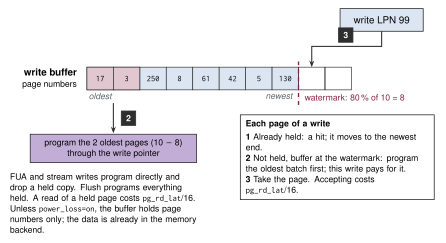
Figure: The BBSSD write buffer with buffer_size=10 and buffer_thres_pcent=80: a write that finds the buffer at its watermark first programs the two oldest pages and pays for them.
The write buffer models DRAM in front of the NAND. It holds logical page
numbers, not data: a write it accepts costs a DRAM access, and the program
is charged later to whatever forces the page out. Repeated writes to a
buffered page cost one program. The code is in
hw/femu/bbssd/ftl-datapath.c.
  host write, pages P..Q
        |
        v
  forced GC if free lines <= high watermark; one read-reclaim step
        |
        v
  buffer enabled, not FUA, not a stream write? ---- no ----+
        | yes                                              |
        v                                                  v
  for each page:                                  drop buffered copies of
    already held? -> move to tail, write hit      these pages; if the cache
    else if count >= watermark:                   was disabled, write back
        write back `batch` pages from the head    everything
        (oldest first), cost charged to this                |
        write                                               v
    insert at tail                                program each page
        |                                         (NAND time)
        v
  latency = max(DRAM access, write-back cost)

  watermark = max(1, (int)(buffer_size * buffer_thres_pcent / 100))
  batch     = max(1, buffer_size - watermark)
  DRAM access = pg_rd_lat / 16 (1000 ns when pg_rd_lat is 0)
- Structure. A tail queue in order of last write, LRU (
write_buffer) and a GLib tree keyed by LPN (wb_tree) for lookup. Capacity isbuffer_sizepages. - Admission is per page. A command larger than the buffer cannot push it past its size: it writes back a batch whenever the buffer is at the watermark. If a write-back frees nothing because the device is out of lines, the write fails with Capacity Exceeded.
- Write-back (
ssd_buffer_destage()) takes pages from the head (the least recently written), runs forced GC as needed, charges the DFTL lookup and programs each page exactly as a direct write would. Hybrid merges after each page as usual; FAST merges once per batch. A page costs the same buffered or not; only the request that pays differs. - Reads. A read of a buffered page costs one DRAM access and does not reach NAND, even when the buffer has stopped accepting writes.
- FUA and stream writes program directly. A direct write first drops any buffered copy of its own pages, so an older version is never programmed after the newer one.
- Deallocate drops buffered copies before unmapping, so discarded data is never programmed later.
- Flush reaches the FTL like any other command and writes back the whole buffer, charged to the Flush.
- Volatile write cache. With
vwc=1the controller advertises a cache. When the host turns it off with feature 06h, the buffer stops accepting writes and the next write drains it. Withvwc=0the buffer still works, and the host has no way to turn it off; Linux sends no Flush to a controller that advertises no cache.
host_write_pages counts pages when the host writes them and
nand_write_pages when they are programmed, so a buffer that absorbs
overwrites makes the write amplification factor drop below 1.
Power loss
With power_loss=on, the poller no longer touches payload: the FTL thread
runs the whole I/O command (nvme_power_io()), so the data copy and the
buffer change together. The first time a page enters the buffer, the FTL
saves the page's previous bytes and per-LBA state as an undo record. When
the page is programmed the record is dropped. Setting the QOM property
simulate-power-loss (runtime properties)
resets the controller, restores every buffered page from its undo record,
empties the buffer and counts an unsafe shutdown.
In this mode a normal shutdown, turning the cache off and Sanitize first write back every namespace's buffer; Flush, Format, Dataset Management, Copy, Write Zeroes (except on a PI-formatted namespace) and Write Uncorrectable write back their own namespace's. If the device has no line to write to, they fail with Capacity Exceeded (a shutdown sets Controller Fatal Status instead) rather than claim the data is durable. An FUA write programs a whole NAND page, so buffered neighbours in that page become durable with it.
Read cache
read_cache_mb adds a DRAM read cache in front of NAND reads
(hw/femu/bbssd/ftl-cache.c). Like the write buffer it holds LPNs only.
  host read of a mapped lpn (not in the write buffer)
        |
        v
  lookup in an open-addressed hash over capacity slots
     hit:  cost pg_rd_lat / 16, no NAND read, no block read count
     miss: insert (evict by cache_evict if full), then NAND read
- Capacity is
read_cache_mbMiB divided by the page size. - Only reads fill it. A host overwrite, a deallocate and a power cut remove the page's entry. A GC relocation does not, since the content is the same.
cache_evictpicks the victim:clock(second chance),random(a fixed-seed generator, so runs repeat),lru(exact, by scan) orarc, a scan-resistant 2Q variant that evicts pages read once before pages read twice. It is not full ARC.- Hit and miss counts are kept in
ssd->rcachebut not exported.
Deallocate, Write Zeroes, Format and Sanitize
- Dataset Management deallocate (
ssd_trim()) unmaps every LPN of every range: it drops the buffered copy, invalidates the physical page, clearsmaptblandrmap, and drops the read cache entry. A log-block scheme does this through itstrim()hook. A range past the device is skipped. The latency istrim_lat_nstimes the number of ranges, or 0. - Write Zeroes with Deallocate unmaps the range in the same way and costs no time. Without Deallocate it programs the range directly, after forced GC if needed, and counts the pages as host writes.
- Format and Sanitize call
bbssd_deallocate_all()on BlackBox namespaces (not CSD), which unmaps every LPN of the namespace's FTL. The lines keep their wear.
ONCS bit 0x8 (Write Zeroes) and 0x100 (Copy) are off unless oncs sets them.
Wear, read reclaim and retention refresh
Program/erase cycles
Every erase increments the block's erase_cnt and the FTL-wide
total_erases. SMART Percentage Used is
percentage_used = min(255, total_erases * 100 / (tt_blks * rated_pe_cycles))
where rated_pe_cycles is pe_cycles_rated, or the rating of
nand_cell_type (SLC 100000, MLC 3000, TLC 1000, QLC 300), or 0, in which
case the field reads 0. nand_bad_blocks marks a number of blocks as
factory bad for SMART Available Spare only: 100 - bad * 100 / tt_blks.
Placement ignores them. With several namespaces the controller reports the
most worn namespace and the lowest spare.
With ecc_step_ns set, a block's erase count (one tier per 750 erases) and
the age of its line add time to each read. That model belongs to the NAND
timing chapter.
Read reclaim and retention refresh
  host NAND read of block B in line L
        |
        +-- read_reclaim_limit set and B.read_cnt >= limit   --+
        +-- retention_limit_sec set and now - L.close_time >= -+--> queue L
            limit                                              (one line at
                                                                a time)
  next host write:
        |
        v
  do_read_reclaim(): queued line, high watermark not reached,
  at least 2 free lines, L full or in the victim queue?
        | yes
        v
  take L out of its list, reclaiming = true, collect L like GC
  read_reclaims++ or retention_refreshes++
Every NAND read the FTL issues, host, GC or merge, increments its block's
read_cnt (GC reads are issued only while GC timing is on); an erase
resets it. Reads answered by the write buffer, the read cache or a DFTL
translation page do not count. The rewrite happens on a write, where
relocation already costs something, so a read never stalls behind a whole
line. One line is refreshed per write at most. A line that nothing reads is
never refreshed, and a workload that only reads refreshes nothing: FEMU runs
no background media scan. The request is dropped if GC collects the line first, or if the line is
still open for writing when the next write checks it.
Fault insertion
err_read_unc_ppm and err_write_fail_ppm turn a rate into a period,
1000000 / ppm, at least 1. Every Nth Read command completes with
Unrecovered Read Error and every Nth Write command with Write Fault. The
counters run per namespace FTL, so a run repeats exactly. The command is
still timed and, for a write, still programmed and mapped; only its status
changes. The injected counts feed SMART Media and Data Integrity Errors.
Write Zeroes and Copy are never failed.
Over-provisioning and capacity
The reserve
bb_check_capacity() in hw/femu/bbssd/bb.c refuses a namespace that would
leave GC no room. The reserve, in lines:
  reserve = gc_thres_lines_high      forced watermark, with its floor
          + 1                        data pointer
          + 1 if hot_cold_sep        hot pointer
          + 1 if mapping is hybrid or fast   log pointer
          + streams.max + 1 if streams       stream and stream GC pointers

  usable  = (blks_per_pl - reserve) * pages_per_line * page_size
  refused when the namespace is larger than usable,
  or when blks_per_pl <= reserve
Each namespace has its own FTL built from the whole geometry, so the check applies per namespace.
Sizing the namespace
Without op_pcent, the backend is devsz_mb MiB, split across the
namespaces, and the spare area is whatever the geometry has beyond that.
With op_pcent, the backend is the raw NAND capacity and each namespace
gets raw * 100 / (100 + op_pcent) / namespaces, rounded down to 512 bytes
(an even split unless namespace_sizes is given); devsz_mb is ignored.
Worked example: the default geometry
The default properties describe 8 channels x 8 LUNs x 1 plane x 256 blocks x 256 pages x 8 sectors x 512 bytes:
  page            = 8 x 512                      = 4 KiB
  NAND pages      = 8 x 8 x 1 x 256 x 256        = 4,194,304
  raw capacity    = 4,194,304 x 4 KiB            = 16 GiB
  lines           = blks_per_pl                  = 256
  blocks per line = 8 x 8 x 1                    = 64
  pages per line  = 64 x 256                     = 16,384   (64 MiB)

  background GC   = (int)(0.25 x 256)            = 64 free lines  (75% used)
  forced GC       = (int)(0.05 x 256)            = 12 free lines  (95% used)
  victim filter   = 16,384 / 8                   = 2,048 invalid pages

  reserve         = 12 + 1                       = 13 lines
  usable          = 243 x 64 MiB                 = 15,552 MiB

  devsz_mb=12288 (the launcher):  12 GiB = 192 lines of data
     -> the data pointer holds a line from init, so free lines reach
        64 and background GC starts as the last of the 192 lines is
        opened, just before one full pass completes
  op_pcent=25:  16 GiB x 100 / 125               = 13,107.2 MiB exposed
  op_pcent=7:   16 GiB x 100 / 107               = 15,312.1 MiB exposed

  host memory for the FTL: maptbl 32 MiB + rmap 32 MiB
                           + page status 16 MiB + block and line arrays
With the default devsz_mb of 1024 the same geometry exposes 1 GiB, about
6% of the NAND, and GC barely runs. To give GC work on a small device,
shrink the geometry instead; this one has 512 MiB of NAND and exposes about
410 MiB:
-device femu,femu_mode=1,nchs=2,luns_per_ch=4,blks_per_pl=64,op_pcent=25
Run-time controls
Admin opcode 0xEF changes the FTL while the guest runs. Only a BlackBox controller accepts it. Codes 1 to 4 apply to every namespace with an FTL, with the dataplane paused; codes 5 to 7 act on the controller.
| CDW10 | Effect |
|---|---|
| 1 | GC operations take NAND time (the default) |
| 2 | GC operations take no NAND time |
| 3 | flat read, program, erase times back to 40 us, 200 us, 2 ms |
| 4 | flat read, program and erase times to 0 |
| 5 | reset the poller completion counters |
| 6, 7 | turn the per-request log lines on or off |
Codes 3 and 4 set the built-in flat times, not the values given on the
command line, and do not affect nand_cell_type tables. See
changing timing at run time.
Statistics
Vendor log page C0h
nvme_collect_media_stats() in hw/femu/nvme-admin.c sums the FTL counters
over the controller's bbssd, CSD and KV namespaces.
log-pages-and-counters.md
lists the offsets.
| C0h field | FTL counter | Moves when |
|---|---|---|
| WAF x 1000 | (nand + gc) x 1000 / host | after the first host write |
| host write pages | host_write_pages | Write, the destination of Copy, and Write Zeroes without Deallocate, per page, buffered or not |
| GC write pages | gc_write_pages | GC, read reclaim and log-block merges relocate a page |
| NAND write pages | nand_write_pages | a host page is programmed |
| max block reads | largest read_cnt | NAND reads; reset by erase |
| read reclaims, retention refreshes | read_reclaims, retention_refreshes | a queued line is rewritten |
| buffer reads and read hits | sp.read_cnt, sp.read_hit_cnt | host read pages, and those the buffer held |
| buffer writes and write hits | sp.write_cnt, sp.write_hit_cnt | host write pages, and those already buffered |
| hybrid switch, full merges, merge erases | struct femu_map_hybrid | mapping=hybrid only |
The buffer read and write counts move with or without a buffer, so their ratio is the hit rate. Telemetry log 07h captures the same 512 bytes.
SMART and Endurance Group
| Field | Source |
|---|---|
| Percentage Used | ssd_percentage_used(), most worn namespace |
| Available Spare | ssd_available_spare(), lowest namespace; 20 or below sets the spare critical warning |
| Media and Data Integrity Errors | injected read and write faults (and ZNS write faults) |
| Data units, host commands | the pollers' host I/O counters, not the FTL |
| Endurance Group Media Units Written | (NAND + GC write pages) x page size, in units of 10^9 bytes rounded up; needs a femu-subsys |
Counters kept but not exported
DFTL hits and misses (ssd->cmt), read cache hits and misses
(ssd->rcache), FAST merge counts and the per-block erase_cnt stay inside
the FTL. debug_ftl=on prints hybrid and FAST merge counts to stdout.
Parameters
Every property is listed with its type, default and range in the property reference; this table says what each does inside the FTL and what it interacts with.
Geometry and capacity
NAND geometry, mode and capacity
| Property | Effect in the FTL | Interacts with |
|---|---|---|
secsz, secs_per_pg | page size; LPN = byte offset / page size | the LBA format; DFTL entries per translation page |
pgs_per_blk | pages per block and per line column; the log-block merge unit | at most 512 with nand_cell_type |
blks_per_pl | the number of lines | the watermarks and the reserve are fractions of it |
pls_per_lun, luns_per_ch, nchs | line width and write striping | parallelism; tplebsy for multi-plane erase |
devsz_mb, namespaces, namespace_sizes | the exposed capacity | must fit the usable lines per namespace |
op_pcent | exposes a fixed fraction of raw NAND | overrides devsz_mb; refused with cxl_ssd |
Garbage collection, mapping and caches
Garbage collection, mapping and caches
| Property | Effect in the FTL | Interacts with |
|---|---|---|
gc_thres_pcent | background GC watermark | must not exceed gc_thres_pcent_high |
gc_thres_pcent_high | forced GC watermark; sizes the reserve | lower values cost exposed capacity |
gc_policy | line victim selection | refused with FDP |
gc_strategy | reclaim unit victim selection | FDP only |
mapping | L2P scheme | hybrid and fast reserve a line and refuse Streams; FDP needs page |
mapping_cache_mb | DFTL cache size | used only with mapping=dftl |
read_cache_mb, cache_evict | read cache size and eviction | hit time is pg_rd_lat / 16 at realize; 0xEF does not change it |
hot_cold_sep | hot write pointer for overwrites | page or DFTL only; reserves a line; refused with FDP |
buffer_size, buffer_thres_pcent | write buffer capacity in pages, and the write-back watermark | vwc, power_loss; refused with FDP |
fdp_trim_erase_all | FDP deallocate resets every reclaim unit | FDP only |
debug_ftl | prints invalid page transitions and merge counts | none |
Reliability and wear
| Property | Effect in the FTL | Interacts with |
|---|---|---|
pe_cycles_rated | Percentage Used denominator | overrides the nand_cell_type rating |
nand_bad_blocks | Available Spare | placement ignores it |
ecc_step_ns, ecc_retention_sec | read time grows with erase count and line age | ecc_retention_sec refused with FDP |
err_read_unc_ppm, err_write_fail_ppm | fixed-period command failures | counted in SMART media errors |
read_reclaim_limit | read count that queues a line for rewrite | needs host writes to act; refused with FDP |
retention_limit_sec | line age that queues a line for rewrite | same |
NAND timing the FTL charges
The FTL charges trim_lat_ns per deallocate range (refused with FDP) and
issues a multi-plane erase per LUN during GC, whose inter-plane time is
tplebsy. All the other timing properties are applied by the NAND media
layer.
Controller properties the FTL reads
| Property | Where documented | Effect in the FTL |
|---|---|---|
vwc | controller identity | lets the host turn the write buffer off |
oncs | same | Write Zeroes and Copy reach the FTL only when enabled |
power_loss | power loss | undo records and simulate-power-loss |
streams, streams.max | same | per-stream write pointers; reserve streams.max + 1 lines |
Interactions and refusals
- FDP refuses
buffer_size,hot_cold_sep,read_reclaim_limit,retention_limit_sec,ecc_retention_sec,trim_lat_ns, amappingother thanpageand agc_policyother thangreedy, withFEMU bbssd: <name> has no effect under FDP. - Unknown names for
mapping,gc_policyandcache_evictare refused at realize. - Watermarks outside [1, 100], or a high watermark below the low one, are refused.
- The write buffer is off when
power_loss=onandvwc=0, and while the host has the advertised cache turned off. - DFTL cache size has no effect under
page,hybridorfast.
Examples, each checked by check-doc-examples.py:
-device femu,devsz_mb=1024,femu_mode=1,mapping=dftl,mapping_cache_mb=8
-device femu,devsz_mb=1024,femu_mode=1,hot_cold_sep=on,gc_policy=cost-benefit
-device femu,devsz_mb=1024,femu_mode=1,buffer_size=4096,buffer_thres_pcent=75,vwc=1
-device femu,devsz_mb=1024,femu_mode=1,mapping=hybrid
Validation status
What the automated tests check:
| Area | Test | Checks |
|---|---|---|
| BAST merges | unit test test-femu-hybrid-oracle; qtests hybrid-oracle-*, hybrid-batch-occupancy, hybrid-destage-occupancy, hybrid-switch-trim-erase, hybrid-trim-occupancy | the unit test checks the reference model; the qtests compare FEMU's switch, full merge and erase counts against it, including deallocate and the write buffer |
| Victim queue | unit test test-femu-pqueue | priority queue operations, including random pop |
| NAND timing | unit test test-femu-nand-media | the media layer the FTL calls |
| C0h counters | qtest media-counters | host and NAND page counts and the WAF move with writes |
| Write buffer | qtest buffer-counters, flush-without-vwc and power-loss-* | hit counts; Flush (also with vwc=0), FUA, write-back, cache disable, shutdown and power-cut rollback |
| Streams | qtest streams-gc and the other streams-* cases | stream placement and GC of stream lines |
| GC with no free line | qtests gc-no-destination, gc-no-destination-hot-cold, streams-gc-floor, gc-no-destination-fdp | on a geometry whose forced watermark rounds to zero, random single-page and 64-page writes never fail, no mapping names an erased page and no valid page is orphaned (read through the qtest-only x-ftl-check property) |
| Format, Sanitize | qtests format-ftl, sanitize | after Format, GC relocates nothing; Sanitize status and zeroed data (the FTL state is not checked) |
| Robustness | qtests io-fuzz, io-fuzz-fdp, config-refused | malformed I/O, refused configurations |
| Start-up | doc-examples | every tagged example on this page and the BlackBox guide starts and moves one block |
No automated test checks the behaviour of the random, cost-benefit,
fifo and d-choice policies, dftl and fast mapping, hot/cold
separation, the read cache, read reclaim, retention refresh, read and write
fault insertion on BlackBox, or the wear and spare figures. They are covered only by the
start-up examples and by guest runs during development; femu-test.sh
(guest-side tests) checks that the
counters move. FEMU's latencies and write amplification have not been
calibrated against a specific commercial drive.
Limits
- Data placement is modelled per page; the FTL never tracks sectors within a page, so writes smaller than a page cost a whole page program.
- GC relocations go through the data pointer (or a stream pointer for stream data), never back to the victim's LUN (no copyback), and GC runs on the FTL thread, one line at a time.
- There is no explicit wear levelling, and bad blocks do not affect placement.
- Read reclaim and retention refresh act only on reads followed by writes.
d-choiceGC is not reproducible run to run, andrandomonly when everything else that callsrand()repeats too.- An injected write fault still programs and maps the data.
- FAST merge counts and DFTL and read cache hit rates are not exported.
- Each namespace's FTL is built from the whole geometry, so host memory for the FTL grows with the namespace count.
Extending the FTL
Adding a GC victim policy
- Write
static struct line *select_victim_line_<name>(struct ssd *ssd, bool force)inhw/femu/bbssd/ftl-line-gc.c. Candidates are the lines inssd->lm.victim_line_pq; slots1tosize - 1ofpq->d[]hold them. - Apply the background filter: when
!forceand the line has fewer thanpgs_per_line / 8invalid pages, return NULL and leave the queue as it was. - Remove the chosen line with
pqueue_remove()(orpqueue_pop()for the top), setline->pos = 0and decrementlm->victim_line_cnt.reclaim_line()expects a line that is in no list. - Add
{ .name = "<name>", .select_victim_line = ... }tofemu_ftl_policies[].femu_ftl_policy_known()then accepts the name. - Describe it in the
gc_policydescription inhw/femu/femu-props.c, regenerate the property reference, and add a qtest that tells the policy apart from greedy.
Adding a mapping scheme
- Implement
struct femu_mapping_opsin a newftl-map-<name>.c: at leasttranslate,prepare_write,commit_writeandgc_relocate_commit. Keepmaptblandrmapcorrect:commit_writemust invalidate the old page and set both tables, because GC and reads depend on them. - Keep private state in
ssd->map_priv, allocated ininitand freed inexit. - Set
uses_log_classif writes go through the LOG pointer; the reserve then grows by one line and Streams are refused. Setuses_cmtto get the DFTL cost model. - For merges, provide
needs_reclaimandreclaim(ssd, budget).reclaim()charges its own NAND operations and returns the latency to add to the triggering request.reclaim_per_pageruns it after every page instead of once per request. Allocate a destination before invalidating the source, so a full device never loses the only copy. - Provide
trimif the scheme keeps per-page state. - Add the ops to
femu_mapping_extra[]inhw/femu/bbssd/ftl-map.c, declare them inftl-internal.h, and add the file to the FEMU source list inhw/femu/meson.build.
Run the unit tests and the qtests (testing guide), and check that the C0h counters move for the new code path: a counter that never changes in a mode means the mode is not reached.
Source map
| File | Contents |
|---|---|
hw/femu/bbssd/bb.c | mode registration, bb_check_capacity(), FDP refusals, the 0xEF switch, teardown |
hw/femu/bbssd/ftl.c | ssd_init(), bb_ftl_process_req(), Copy, counters, Percentage Used, Available Spare, ssd_free() |
hw/femu/bbssd/ftl.h | struct ssd, struct ppa, lines, write pointers, the mapping and policy ops |
hw/femu/bbssd/ftl-internal.h | address helpers, ssd_lpn_range(), GC watermark tests |
hw/femu/bbssd/ftl-geom.c | bb_check_geometry(), ssd_init_params(), NAND array allocation |
hw/femu/bbssd/ftl-datapath.c | read, write, write buffer, deallocate, Write Zeroes, power-loss rollback |
hw/femu/bbssd/ftl-line-gc.c | lines, write pointers, Streams pointers, GC, victim policies, read reclaim |
hw/femu/bbssd/ftl-map.c | maptbl, rmap, page and DFTL schemes, scheme registry |
hw/femu/bbssd/ftl-map-cmt.c | DFTL cached mapping table cost |
hw/femu/bbssd/ftl-map-hybrid.c | BAST log-block scheme and its C0h counters |
hw/femu/bbssd/ftl-map-fast.c | FAST log-block scheme |
hw/femu/bbssd/ftl-cache.c | read cache and its eviction policies |
hw/femu/bbssd/ftl-media.c | bridge to the NAND media layer, block read counts |
hw/femu/bbssd/ftl-fdp.c | FDP reclaim units, handles and their GC |
hw/femu/bbssd/ftl-exp.c | debug tracing of marked pages, off unless FEMU_EXP_LOG or FEMU_DUMP_LPN is set |
hw/femu/femu.c | the FTL thread, op_pcent sizing, simulate-power-loss |
hw/femu/nvme-admin.c | C0h, SMART and Endurance Group counters, Sanitize, the cache feature |
Related pages
- BlackBox guide: launch, guest use, refusals
- Timing model
- Architecture
- Measuring
- Log pages and counters
- Property reference