FDP: Flexible Data Placement
This page is hw/femu/docs/design/fdp.md at FEMU 39a55eeb6 (2026-10-02), licensed GPL-2.0-or-later. Send corrections to the FEMU repository.
This chapter describes how FEMU implements NVMe Flexible Data Placement (FDP): how the subsystem builds reclaim groups, reclaim units and reclaim unit handles, how a write is placed, how reclaim units map onto the BlackBox FTL's NAND, how garbage collection works under placement, and what the FDP log pages and features report. To launch an FDP device and write with placement identifiers from a guest, read the FDP feature guide first. FEMU's FDP support comes from WARP (FAST '26); the guide has its citation.
Purpose
FDP lets the host group writes it expects to die together. The device offers reclaim unit handles (RUHs); each write may name one through a placement identifier, and the device puts all writes of one handle into the same open reclaim unit (RU). When an RU holds data of similar lifetime, it is mostly invalid by the time garbage collection picks it, so GC copies less and write amplification drops. FEMU models the host-visible FDP interface and backs it with a placement-aware write and GC path in the BlackBox FTL, so you can measure that effect.
FDP is not a femu_mode. It is turned on with fdp=on on a femu-subsys
device, and a controller joins the subsystem with subsys=. Only a BlackBox
(bbssd) namespace has the placement data path.
Place in the hierarchy
 femu-subsys device, fdp=on              NVMe subsystem
   |  endurance group 1 (NvmeEnduranceGroup.fdp)
   |    configuration: nrg reclaim groups x nru reclaim units, nruh handles
   |    host-visible state: RUH type and attributes, RUAMW per RU,
   |    HBMW/MBMW/MBE, host and controller event rings
   |
   +-- femu device, femu_mode=1, subsys=   one controller
         |
         +-- namespace 1                     placement handles PH 0..nruh-1
               |                             (PH i -> RUH i)
               +-- struct ssd (BlackBox FTL)
                     FemuRuHandle[nruh]       current RU, GC RU, counters
                     FemuReclaimGroup[nrg]    free list, full list,
                                              victim queues
                     FemuReclaimUnit[nru]     one line (superblock) each,
                                              write pointer, valid pages
                     lines -> blocks on every channel, LUN and plane
Two layers of state exist side by side. The subsystem holds what the host
sees (NvmeRuHandle, NvmeReclaimUnit with its RUAMW, the statistics and
events) in nvme.h. The FTL holds what places and collects data
(FemuRuHandle, FemuReclaimGroup, FemuReclaimUnit in
bbssd/ftl.h). Each FTL object points at its host-visible twin, and the
write path updates both.
Configuration
nvme_subsys_setup_fdp() in femu.c builds one endurance group (ID 1)
with a single FDP configuration when the subsystem is realized:
| Item | Value | Property |
|---|---|---|
| Reclaim groups (NRG) | 1; any other value is refused | fdp.nrg |
| Reclaim units per group | as set, at most 65536 | fdp.nru |
| Reclaim unit handles (NRUH) | 1 to fdp.nru; must be set | fdp.nruh |
| Handle type (RUHT) | Persistently Isolated; with fdp.isolation_mode non-zero the last handle is Initially Isolated | fdp.isolation_mode |
| Reclaim unit size (RUNS) | one BlackBox superblock (see below); the subsystem default of 96 MiB applies only when no bbssd controller overwrites it | fdp.runs |
| Reclaim group identifier format (RGIF) | 0 with one group | derived |
| MAXPIDS | 128 (reported zero-based as 127) | fixed |
| Event filter | every supported event type enabled on every handle | Set Features 1Eh |
When a controller joins, nvme_ns_init_fdp() gives namespace 1 every
handle in order: placement handle i is RUH i, the namespace's ENDGID is
1, and each handle's RUAMW starts at a full unit. The controller then sets
CTRATT bits 4 (Endurance Groups) and 19 (FDP) and ENDGIDMAX = 1, and the
effects log lists I/O Management Send and Receive.
The BlackBox side (bb.c, ftl-fdp.c) adds the following, for a CSD
namespace as for a bbssd one, since CSD runs the same FTL
(bb_init_fdp()):
-
RUNS is overwritten with the bytes of one superblock:
nchs * luns_per_ch * pls_per_lun * pgs_per_blk * secs_per_pg * secsz.fdp.runsmust be unset or exactly that. -
The FTL uses
min(lines, fdp.nru)reclaim units, one line each (lines_per_ru = 1). Lines left over are not used by the placement write path. -
It needs at least
fdp.nruh * fdp.nrg + fdp.nruh + 1units: one open unit per handle, one collection unit per handle, and one spare. -
gc_thres_pcentandgc_thres_pcent_highset the free-unit watermarks instead of free-line watermarks. The forced watermark keeps at least one unit free, even where the percentage rounds to none, unlessgc_thres_pcent_highis 100 (bb_fdp_forced_units()): a pass can fill its destination part way through a victim and needs a free unit to go on. -
The namespace must fit in the units left after the reserve (
bb_check_capacity()), or the controller is refused at realize:reserve = fdp.nruh * fdp.nrg one open unit per handle and group+ Persistently Isolated handles one collection unit each+ forced watermark free units forced GC keepsusable = (units - reserve) * superblock sizeThe Initially Isolated handle collects into its open unit and adds nothing. One namespace is checked against the whole pool because nothing else can draw on it: FDP takes a single namespace and a single controller, and namespace management is refused with it. A 1 MiB namespace on 64 KiB superblocks with four Persistently Isolated handles needs 16 + 4 + 4 + 1 = 25 units; with 19 or 23 lines, both accepted before, random writes over all four handles failed nearly all of them. A partly exposed last page counts as a whole one. bbssd refuses a namespace that does not fit rather than shrink it, as it does without placement and with
op_pcent.
Placement of writes
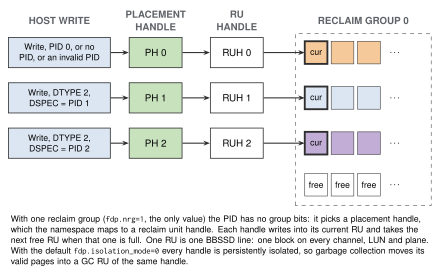
Figure: FDP placement on a BBSSD: a write's placement identifier picks a placement handle, the namespace maps it to a reclaim unit handle, and the handle fills its current reclaim unit (one FTL line) before taking a free one.
 Write: CDW12 bits 23:20 DTYPE, CDW13 bits 31:16 DSPEC
   |
   | DTYPE == 2 (data placement) and DSPEC is a valid placement identifier?
   |   no  -> placement handle 0, reclaim group 0
   |          (if DTYPE was 2: host event "Invalid Placement Identifier")
   |   yes -> PID = (RG << (16 - RGIF)) | PH ;  with RGIF 0, PID = PH
   v
 PH --ns->fdp.phs[]--> RUH --curr_ru--> active RU --wptr--> next page
   |
   | per FTL page (secsz * secs_per_pg, 4 KiB by default): invalidate the old copy, map LPN -> new page,
   | RUAMW -= logical blocks written, advance the write pointer,
   | charge a NAND program
   v
 RU full -> retire it (full list or victim queue), take a free RU
            for this handle; none free -> Capacity Exceeded
ssd_stream_write_lpns() does this on the FTL thread. Write, Write Zeroes
without the Deallocate bit, and the destination of Copy all go through it;
Copy and Write Zeroes read their placement fields from the same CDW12 and
CDW13 bits.
The order inside ssd_stream_write_lpns() is:
- If the handle has no active unit (the last one filled and no free unit was left), take a free unit without running GC; if there is none, fail with Capacity Exceeded. A unit that fills on a command's last page therefore makes the next write to that handle fail when the device is full.
- Run foreground GC while the free-unit count is at or below the high watermark (see Garbage collection).
- Place the pages, running foreground GC again before each one: a command can take more units than the watermark keeps free. If the device runs out part way, the command completes with Capacity Exceeded and only the pages already placed count.
Writes of different handles never share an RU, but they share the NAND: every RU spans all channels, so concurrent handles compete for the same planes and channel buses.
Reclaim units over NAND
An RU is one BlackBox line: block b on every channel, LUN and plane. Its
write pointer moves across channels first, then LUNs, then planes, then
down the pages of the block, so consecutive pages of one handle land on
different dies:
 RU k = line k (block index k), nchs=4, luns_per_ch=2, pls_per_lun=2

 page order:   ch0/L0/pl0  ch1/L0/pl0  ch2/L0/pl0  ch3/L0/pl0
               ch0/L1/pl0  ch1/L1/pl0  ch2/L1/pl0  ch3/L1/pl0
               ch0/L0/pl1  ...                     ch3/L1/pl1   <- page 0 done
               ch0/L0/pl0 (page 1) ...                          <- page 1
               ...                                 last page    <- RU full

 RUNS = all of that = one superblock
fdp_advance_ru_pointer() implements the order; fdp_get_new_page()
turns the pointer into an address. The NAND timing of each program is the
BlackBox timing (see NAND timing).
Reclaim Unit Handle Update
I/O Management Send with operation 1 (RUH Update) lists placement
identifiers. The poller checks every identifier first and fails the command
with Invalid Field if one is invalid, so nothing changes. On a bbssd
namespace ssd_fdp_update_ruhs() then, for each handle:
- skips a handle that has no current unit (device full); the command still succeeds;
- keeps the current unit if nothing was written to it yet;
- otherwise takes a fresh unit (running one GC pass if none is free) and retires the old one as if it had filled, or fails the command with Capacity Exceeded if no unit can be freed;
- in both cases records a host event "Reclaim Unit Not Fully Written" when the unit still had room (RUAMW not zero) and that event is enabled on the handle, so an update of a handle whose unit is still empty records one too.
I/O Management Receive with operation 1 (RUH Status) returns one descriptor per placement handle and reclaim group: PID, RUHID, EARUTR (always 0) and the RUAMW of the handle's current unit, or 0 while the handle has none because its last unit filled with no free unit to follow it.
Garbage collection
                take (handle needs a unit)
   +--------+ -------------------------> +--------+
   |  free  |                            | active |  curr_ru of one handle,
   +--------+ <---------+                +--------+  or a handle's GC unit
        ^               |                    |
        |               | GC: relocate       | full (or left by RUH Update)
        |               | valid pages,       v
        |               | erase blocks   all pages valid?
        |               |                 yes -> full list
        |               |                 no  -> victim queue(s)
        |               |                    |
        |               +--------------------+  a page in a full-list unit
        |                                       is invalidated: unit moves
        +-- erased unit returns to the free list of its reclaim group
When it runs
- Background: after every request the FTL thread handles, if a reclaim
group's free units are at or below
(1 - gc_thres_pcent / 100) * units, it runs one pass. A background pass puts its victim back, whatever the policy, unless the victim is empty or at least 1/8 of its pages are invalid. - Foreground: before a placed write and before each of its pages, while
free units are at or below
(1 - gc_thres_pcent_high / 100) * units(at least one unlessgc_thres_pcent_highis 100), it runs passes until the pressure clears or no victim is left. The host write waits for them. Foreground passes, and the pass RUH Update may run, always collect their victim.
Victim selection
gc_strategy selects the policy. The BlackBox gc_policy property does
not apply under FDP and only greedy is accepted with it.
gc_strategy | Policy |
|---|---|
| 0 (default) | greedy: the unit with the fewest valid pages |
| 1 | cost-benefit: an empty unit first, otherwise the largest (1 - u) * age / u, with u the valid pages over the pages written (over the unit's pages until a page is invalidated) and age the time since a page in the unit was last invalidated, computed at selection time; a unit never invalidated counts as maximally old |
| 2 | random among the victims |
| 4 | per handle: the unit with the fewest valid pages among the per-handle queues of Persistently Isolated handles, falling back to greedy |
Where relocated data goes
The handle type decides the destination of the valid pages, which is what "isolation" means here:
 victim from a Persistently Isolated handle h
     -> h's own GC unit (gc_ru, taken from the free list on demand)
        data of h stays apart from every other handle, before and after GC

 victim from an Initially Isolated handle
     -> the current unit of the last handle (RUH nruh-1)
        data may be mixed with other relocated data after GC
With the default fdp.isolation_mode=0 every handle is Persistently
Isolated. With it set, only the last handle is Initially Isolated, so its
relocated data goes back into its own current unit.
A pass copies every valid page of the victim, invalidating each old copy as
it goes, and only then erases the planes of each LUN as one multi-plane
erase when enable_gc_delay is on (the default). It adds the copied bytes
to MBMW and the erased bytes to MBE, records a controller event for the
handle, and returns the unit to the free list. If the destination runs out
of space part way, the pass stops before erasing anything: the pages already
moved live at their new location, the rest stay in the victim, and the
victim goes back on the queue to be finished by a later pass.
Both destinations can be left without a unit: one that fills with no free unit to follow it is dropped. The next pass with a page to move takes a free unit for it from the victim's reclaim group, whatever state the handle's own current unit is in. A victim with no valid page left needs no destination, so it is collected even when no unit is free; that is how a device that ran out gets a unit back once the host deallocates or overwrites data.
Deallocate
Dataset Management deallocate on an FDP namespace unmaps the given ranges;
the pages become invalid and GC reclaims their units later. Write Zeroes
with the Deallocate bit does the same. fdp_trim_erase_all (test only)
instead resets every unit, handle and mapping on any Dataset Management
deallocate, ignoring the ranges; Write Zeroes with Deallocate still unmaps
only its range.
Log pages and features
All four FDP log pages take endurance group 1 in the Log Specific Identifier, and need a subsystem; 21h, 22h and 23h fail with FDP Disabled when FDP is off. The supported log pages list (00h) shows them only while FDP is on.
| Log | Content | Code |
|---|---|---|
| 20h FDP Configurations | header with NUMFDPC 0 (one configuration), then one descriptor: FDPA (valid, RGIF), NRG, NRUH, MAXPIDS, NNSS 256, RUNS, and NRUH handle descriptors with the RUHT of each handle | nvme_fdp_confs() |
| 21h Reclaim Unit Handle Usage | header with NRUH, then one descriptor per handle with its RUHA (1 = host-specified for every handle the namespace was given) | nvme_fdp_ruh_usage() |
| 22h FDP Statistics | HBMW, MBMW and MBE as 128-bit counters; FEMU fills the low 64 bits | nvme_fdp_stats() |
| 23h FDP Events | number of events, then the events of the ring selected by LSP bit 0 (1 = host events, 0 = controller events) | nvme_fdp_events() |
The 21h layout
The log is an 8-byte header followed by one 8-byte Reclaim Unit Handle
Usage Descriptor per handle, as the specification defines it. Each
descriptor holds the handle's RUHA in byte 0, and bytes 1 to 7 are
reserved. NvmeRuhuDescr in nvme.h has that layout, and a
QEMU_BUILD_BUG_ON keeps it at 8 bytes. The log is 8 + 8 * NRUH bytes:
 offset      content
 0           NRUH (2 bytes), reserved (6 bytes)
 8           handle 0: RUHA, reserved
 16          handle 1: RUHA, reserved
 8 + 8 * i   handle i: RUHA, reserved
The log carries no per-handle byte counters. The endurance-group totals are in 22h.
Statistics
| Counter | Grows by | Where |
|---|---|---|
| HBMW (host bytes with metadata written) | bytes a Write, Copy or Write Zeroes without Deallocate actually programmed | fdp_count_write() |
| MBMW (media bytes with metadata written) | the same host bytes, plus bytes relocated by GC | fdp_count_write(), do_gc_fdp_style() |
| MBE (media bytes erased) | bytes of every block erased by GC | do_gc_fdp_style() |
The ratio MBMW / HBMW is the write amplification of the endurance group.
The counters are charged after the write, from the pages it placed, so a
write that ran out of space adds only what it wrote. They are reset by a
deallocate with fdp_trim_erase_all set.
Events
There are two rings of 63 events each, one for host events and one for controller events. When a ring is full the oldest event is overwritten. Each event carries the Timestamp feature's current value.
| Type | Ring | Generated when |
|---|---|---|
| 0h Reclaim Unit Not Fully Written | host | RUH Update moves a handle off a unit that still had room |
| 3h Invalid Placement Identifier | host | a placed write (Write, Copy, Write Zeroes) on a bbssd namespace has DTYPE 2 and a DSPEC that is not a valid PID; checked against the event filter of placement handle 0; other modes never raise it |
| 81h (implicit reclaim unit change) | controller | GC frees a unit of the handle |
| 1h, 2h, 80h | accepted by the event filter, never generated |
Get and Set Features 1Eh (FDP Events) read and change the enabled event types of one placement handle, named in CDW11; an unsupported type in a Set fails with Invalid Field. Get Features 1Dh (FDP Mode) for endurance group 1 reports whether FDP is on. Set Features 1Dh fails with Invalid Field for an endurance group other than 1 or without a subsystem, and otherwise with Command Sequence Error, since the mode may only change while the endurance group has no namespaces and FEMU builds the namespace at realize.
Threads, locks and where latency is charged
| Work | Thread | Notes |
|---|---|---|
| Parsing DTYPE and DSPEC, validating RUH Update identifiers, I/O Management Receive | poller | data copy to the DRAM backend happens here too |
| Placement, RU rotation, GC, deallocate, RUH Update on bbssd | FTL thread | sole owner of the FTL structures |
| Event append | poller or FTL thread | events_lock in the endurance group |
| Log pages 20h to 23h, Features 1Dh and 1Eh | admin path | 23h reads under events_lock |
A placed write is charged the largest NAND program latency of its pages,
after any foreground GC passes, whose erases and relocations occupy the
same LUNs. GC programs and erases use the BlackBox timing with
enable_gc_delay (see the FTL chapter).
Parameters
Subsystem properties are in the Flexible Data Placement section of the property reference; the controller-side ones are under garbage collection, mapping and caches.
| Property | On | Effect and interactions |
|---|---|---|
fdp | femu-subsys | Turns FDP on. Refused together with ns_mgmt=on. |
fdp.nruh | femu-subsys | Handles and placement handles. Required. Raises the units the geometry must supply. |
fdp.nru | femu-subsys | Units per group; the FTL uses at most one per line. |
fdp.nrg | femu-subsys | Must be 1. |
fdp.runs | femu-subsys | Unset, or the superblock size. |
fdp.isolation_mode | femu-subsys | Non-zero makes the last handle Initially Isolated. |
gc_strategy | femu | Victim policy, above. No effect without FDP. |
fdp_trim_erase_all | femu | Whole-device reset on deallocate. No effect without FDP. |
gc_thres_pcent, gc_thres_pcent_high | femu | Background and foreground watermarks, as fractions of the units. |
BlackBox geometry (nchs, luns_per_ch, pls_per_lun, blks_per_pl, pgs_per_blk, secs_per_pg, secsz) | femu | Sets RUNS (one superblock) and the number of lines, hence units. |
Refused under FDP on a bbssd controller: buffer_size, hot_cold_sep,
read_reclaim_limit, retention_limit_sec, ecc_retention_sec,
trim_lat_ns, a mapping other than page, and a gc_policy other than
greedy. Refused on any controller with FDP: more than one namespace, a
second controller in the subsystem, meta, streams, a KV namespace.
Each message is listed in the feature guide.
A device with eight handles, every one Persistently Isolated except the last:
-device femu-subsys,id=fdp8,fdp=on,fdp.nruh=8,fdp.isolation_mode=1 -device femu,devsz_mb=1024,femu_mode=1,subsys=fdp8,gc_strategy=1
Statistics and outputs
| Output | What it shows |
|---|---|
| Logs 20h to 23h | configuration, handle usage, endurance-group byte counters, events |
| Vendor log C0h | write amplification and page counts of the FTL; placed writes count as host and programmed pages, relocations as GC pages (log pages and counters) |
| SMART / Health (02h) | host data units and commands, as for every mode |
FEMU_FDP_DEBUG in QEMU's environment | traces of RU rotation and GC passes on stderr |
Validation
| Check | What it covers |
|---|---|
qtest cases in hw/femu/tests/qtest/femu-test.c | fdp-events, fdp-features, fdp-report-length, fdp-ruh-usage, fdp-write-zeroes, fdp-write-zeroes-placed, fdp-ruh-update, fdp-ruh-update-full, wide-lba-fdp, io-fuzz-fdp, copy-fdp, log-contents-fdp, ns-mgmt-unavailable-fdp, fdp-csd-knobs, fdp-csd-runs |
| Documentation examples | each tagged FDP example starts under qtest and moves one block |
hw/femu/scripts/fdp-test-nvme-admin.sh | in-guest nvme-cli checks against the run-blackbox-fdp.sh configuration; manual |
hw/femu/tests/unit/test-pqueue.c | the priority queue the victim queues are built on |
Limits
- One reclaim group, one FDP configuration, one namespace and one controller per FDP subsystem.
- An RU is exactly one line; RUNS cannot be smaller or larger than a superblock.
- Only bbssd places data. A NoSSD, ZNS or OCSSD controller in an FDP subsystem answers the log pages and features, and RUH Update resets the handle's RUAMW and records event 0h if the unit still had room; no data is placed. CSD uses the bbssd path, with the same refused knobs and RUNS. KV is refused.
- Page mapping only, no write buffer, no read reclaim or retention model under FDP.
- EARUTR is always 0; there is no active reclaim unit time limit, so event 1h is never raised.
- The 128-bit statistics carry only their low 64 bits.
- Metadata, Streams and Namespace Management do not combine with FDP.
How to extend it
- More reclaim groups: the FTL keeps one active unit per handle; a group
other than 0 needs a current unit per (handle, group) before
fdp.nrgcan be lifted innvme_subsys_setup_fdp(). - Larger reclaim units:
lines_per_ruinssd_init_fdp_params()is the hook, butfdp_advance_ru_pointer()retires a unit after its first line; it must walkru->lines[]first. - A new victim policy: add a value to the GC strategy enum in
bbssd/ftl.h, a case inselect_victim_ru(), and accept it in the geometry checks ofbbssd/ftl-geom.c. Keep the two heap positions (posfor the group queue,ruh_posfor a handle queue) separate. - A new event: generate it with
nvme_fdp_record_event()after checking the handle's filter, and add the type tonvme_fdp_events_supported[]andnvme_fdp_evf_shifts[]innvme.h.
Source map
| File | What is there |
|---|---|
hw/femu/femu.c | femu-subsys properties, nvme_subsys_setup_fdp(), nvme_ns_init_fdp(), nvme_ns_refresh_fdp(), single-controller and single-namespace checks, CTRATT |
hw/femu/nvme.h | FDP wire structures (configuration, usage, statistics, events, RUH status), endurance group and handle state, event tables |
hw/femu/nvme-io.c | DTYPE and DSPEC parsing, PID helpers, event recording, I/O Management Send and Receive |
hw/femu/nvme-admin.c | log pages 20h to 23h, Features 1Dh and 1Eh, supported logs, effects log |
hw/femu/bbssd/ftl-fdp.c | reclaim group, unit and handle setup, placed write, RU rotation, RUH Update, GC, deallocate |
hw/femu/bbssd/bb.c | FDP checks on the bbssd geometry and refused knobs, RUNS |
hw/femu/bbssd/ftl.c | FTL-thread dispatch to the FDP paths, background GC trigger |
hw/femu/scripts/run-blackbox-fdp.sh | launcher |