Choosing a mode
This page is hw/femu/docs/concepts/choosing-a-mode.md at FEMU 39a55eeb6 (2026-10-02), licensed GPL-2.0-or-later. Send corrections to the FEMU repository.
An NVMe femu device emulates one kind of SSD, chosen with femu_mode.
Features such as Flexible Data Placement or several namespaces are added on
top of a mode with more properties. The CXL SSD is a separate device type,
femu-cxl-ssd, not a femu_mode.
If you set nothing, you get NoSSD: femu_mode defaults to 2.
femu_mode values
| Value | Name | Emulates |
|---|---|---|
| 0 | OCSSD | An Open-Channel SSD. The host runs the FTL. lver=1 selects Open-Channel 1.2, lver=2 (default) selects 2.0. |
| 1 | BBSSD | A conventional ("black-box") SSD with a device FTL, garbage collection and NAND timing. |
| 2 | NoSSD | An NVMe drive with no media timing. Default. |
| 3 | ZNS | A Zoned Namespace SSD (NVMe Zoned Namespace command set). |
| 4 | CSD | A computational storage drive that runs programs next to the data, on top of the BBSSD FTL. |
| 5 | KV | A key-value SSD (NVMe Key Value command set). |
Any other value fails realize with "femu_mode must be 0 (OpenChannel), 1
(black-box), 2 (no-SSD), 3 (zoned), 4 (computational storage) or 5
(key-value)". With femu_mode=0, an lver other than 1 or 2 fails too.
Decision table
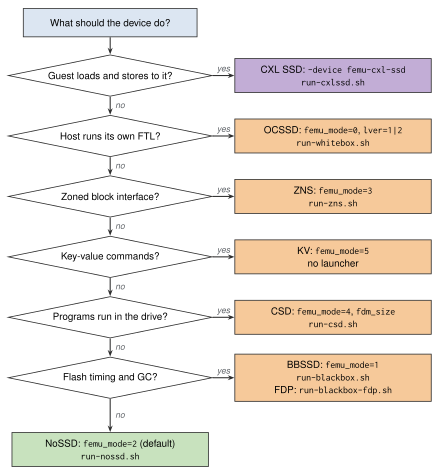
Figure: Choosing a mode: answer the questions top to bottom; the first "yes" names the mode, its femu_mode value and its launcher in hw/femu/scripts/.
Settings are added to -device femu,... unless the row says otherwise. Each
launcher is in hw/femu/scripts/. Each guide covers launch, configuration,
guest-side use, refusals and troubleshooting for its mode or feature.
| Goal | Mode or feature | Key settings | Launcher | Guide |
|---|---|---|---|---|
| Fastest emulated NVMe drive, for host software stack work | NoSSD | femu_mode=2 (or nothing) | run-nossd.sh | NoSSD |
| A conventional SSD with realistic latency, GC and write amplification | BBSSD | femu_mode=1; geometry nchs, luns_per_ch, pls_per_lun, blks_per_pl, pgs_per_blk; timing pg_rd_lat, pg_wr_lat, blk_er_lat | run-blackbox.sh | BlackBox |
| A zoned drive for ZNS-aware filesystems and databases | ZNS | femu_mode=3; zns_num_ch, zns_num_lun, zns_num_plane, zns_num_blk, zns_flash_type | run-zns.sh | ZNS |
| Host-managed flash: your own FTL in the host | OCSSD | femu_mode=0, lver=2 (or 1); lnum_ch, lnum_lun, lnum_pln, lpgs_per_blk | run-whitebox.sh | OCSSD |
| Store and fetch values by key, with no file system | KV | femu_mode=5 | none | KV |
| Run filters or other programs inside the drive | CSD | femu_mode=4, fdm_size (required), nr_cu, csd_program_dir | run-csd.sh | CSD |
| Steer writes to reclaim units to reduce write amplification | FDP on BBSSD | -device femu-subsys,id=s0,fdp=on,fdp.nruh=N before the controller, then femu_mode=1,subsys=s0 | run-blackbox-fdp.sh | FDP |
| Several namespaces on one controller, possibly of different modes | multi-namespace | namespaces=N, optional namespace_sizes=..., namespace_modes=... | none | Several namespaces |
| Create and delete namespaces from the guest | Namespace Management | ns_mgmt=on on a NoSSD or BBSSD controller; bbssd_ns_limit for BBSSD | none | Namespace management |
| Metadata and end-to-end protection information | metadata, PI | meta=8 (or more), mc, pi=on | none | Metadata and PI |
| SSD capacity that the guest uses as memory, with SSD timing on cache misses | CXL SSD | -device femu-cxl-ssd,volatile-memdev=... on a CXL topology; cache-pages, cache-policy, der | run-cxlssd.sh | CXL SSD; design note |
| The same CXL medium also as an NVMe block device | CXL NVMe front end | femu-cxl-ssd first, then -device femu,femu_mode=1,cxl_ssd=<id> | none | CXL NVMe link |
Commas inside a property value are doubled on the QEMU command line, for
example namespace_modes=bbssd,,znssd.
Which features combine
The checks below are made at realize; a combination they refuse stops QEMU with an error naming the rule.
Flexible Data Placement. fdp=on is a property of femu-subsys. Only
BBSSD has an FDP write path; other modes accept a subsystem with FDP, but
placement then has no effect on where data goes. FDP requires a single
controller in the subsystem, a single namespace (namespaces=1), fdp.nrg=1
and fdp.nruh from 1 to fdp.nru. It cannot be combined with a KV namespace,
meta, Streams or a subsystem with ns_mgmt=on. A BBSSD controller under FDP
also refuses buffer_size, hot_cold_sep, read_reclaim_limit,
retention_limit_sec, ecc_retention_sec, trim_lat_ns, a mapping other
than page and a gc_policy other than greedy.
Several namespaces and per-namespace modes. namespaces is 1 to 256. The
backend of devsz_mb MiB is split evenly, or by namespace_sizes.
namespace_modes lists one mode per namespace from nossd, bbssd, znssd,
ocssd, csd and kvssd; without it every namespace runs femu_mode. Limits:
- OCSSD supports one namespace only, and the controller must be OCSSD too.
- At most one CSD namespace per controller.
- ZNS, KV, BBSSD and NoSSD namespaces can be mixed.
metaand Streams need every namespace to be NoSSD or BBSSD.
Namespace Management. ns_mgmt=on takes effect only when the controller
and every namespace are NoSSD, or every one is BBSSD; with other modes, or
with dps, it is accepted and stays off. On a controller that joins a
subsystem without ns_mgmt, it fails realize. To share namespaces between controllers, set
ns_mgmt=on on the femu-subsys instead. A shared subsystem takes NoSSD or
BBSSD controllers that all have the same mode, meta, mc, pi, dpc,
nlbaf, vwc and oncs, and no Streams, dps or namespace_modes.
Metadata and protection information. meta (bytes per block) works on
NoSSD and BBSSD namespaces only, not with FDP, and needs a matching mc bit.
pi=on offers protection information types 1 to 3 when meta is at least 8;
the guest selects one with Format NVM or Namespace Management. pi cannot be
combined with power_loss or cxl_ssd.
CXL NVMe front end. A femu controller with cxl_ssd=<id> must be BBSSD
with one namespace, and must not use namespace_modes, namespace_sizes,
ns_mgmt, subsys, streams, power_loss, buffer_size, op_pcent,
meta, pi or dps. The femu-cxl-ssd must come first on the command line
and have ftl=on. Its geometry and timing apply; the controller's own are
ignored, and devsz_mb must be left at its default or equal the CXL
medium's size.
Other combinations.
- Streams (
streams=on): NoSSD or BBSSD, not with FDP or a shared subsystem; BBSSD needsmappingpageordftl. - Power-loss model (
power_loss=on): BBSSD withbuffer_size> 0, page-aligned namespaces, and nometa,pi,ns_mgmt,subsys,namespace_modesorcxl_ssd. Withoutvwc=1the write buffer holds nothing, so there is nothing to lose. - ZNS needs a logical block size of 4 KiB or less (
lba_index).
Every mode at a glance
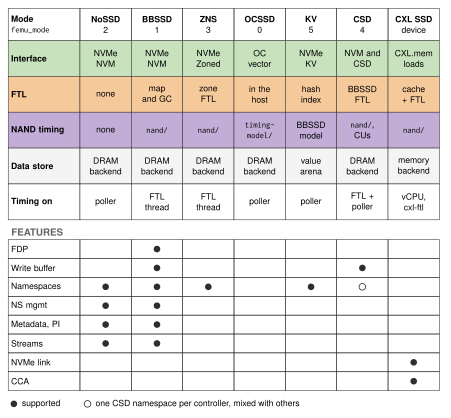
Figure: Modes against layers: the interface each mode offers, where its FTL runs, which timing model it uses, where its data lives and which thread charges its time; below, the features each mode supports (CUs are CSD compute units).
Generated from modes.py: how to turn each mode or feature
on, the guest kernel and tools it needs, what the host needs, and what CI
checks. requirements.md
has the guest kernel configuration in more detail.
| Mode or feature | Use it for | Turn it on with | Guest kernel | Guest tools | Host needs | Launcher | Checked |
|---|---|---|---|---|---|---|---|
| NoSSD | fast NVMe device in DRAM, no flash timing | femu_mode=2 (the default) | any with the NVMe driver | nvme-cli, fio | none beyond the common ones | run-nossd.sh | CI: realize, Identify, write and read back |
| BlackBox SSD (BBSSD) | a commercial SSD: device FTL, GC, NAND timing | femu_mode=1 | any with the NVMe driver | nvme-cli, fio | about 17 GiB free RAM for the launcher's 12 GiB device | run-blackbox.sh | CI: realize, Identify, write and read back; guest: quick start, run end to end |
| Zoned Namespace (ZNS) | zoned storage research | femu_mode=3 | 5.9 or newer with CONFIG_BLK_DEV_ZONED=y; 4 KiB guest pages | nvme-cli 1.12 or newer for nvme zns | none beyond the common ones | run-zns.sh | CI: realize, Identify, write and read back |
| Open-Channel SSD 1.2 | host-managed FTL research | femu_mode=0,lver=1 | 4.16 to 5.14 (LightNVM was removed in 5.15) | LightNVM tools, or SPDK on newer kernels | none beyond the common ones | run-whitebox.sh | CI: realize, Identify |
| Open-Channel SSD 2.0 | host-managed FTL research | femu_mode=0 (lver=2 is the default) | 4.17 to 5.14 (LightNVM was removed in 5.15) | LightNVM tools, or SPDK on newer kernels | none beyond the common ones | run-whitebox.sh | CI: realize, Identify |
| Key-value SSD (KV) | key-value store research | femu_mode=5 | 6.0 or newer; no block device, the namespace is /dev/ngXnY | nvme-cli io-passthru, hw/femu/scripts/kv-probe.c | none beyond the common ones | none | CI: realize, Identify, store and retrieve |
| Computational storage (CSD) | running programs next to the data | femu_mode=4,fdm_size=<MiB> | any with the NVMe driver | hw/femu/tests/csd tools | csd_program_dir for shared-library programs; --enable-csd-ubpf build for eBPF programs | run-csd.sh | CI: realize, Identify, write and read back |
| Flexible Data Placement (FDP) | placement hints on a BBSSD | femu-subsys,fdp=on,fdp.nruh=<n> and femu,femu_mode=1,subsys=<id> | any with the NVMe driver; placement hints need passthrough or io_uring commands | nvme-cli with nvme fdp | none beyond the common ones | run-blackbox-fdp.sh | CI: realize, Identify, write and read back |
| Multiple namespaces | several namespaces, each with its own mode | namespaces=<n>, optionally namespace_sizes and namespace_modes | any with the NVMe driver (ZNS namespaces need what ZNS needs) | nvme-cli | none beyond the common ones | none | CI: realize, Identify, write and read back |
| Namespace management | create, delete and attach namespaces at run time | ns_mgmt=on on a NoSSD or BBSSD controller; femu-subsys,ns_mgmt=on to share namespaces | any with the NVMe driver | nvme-cli create-ns, attach-ns | none beyond the common ones | none | CI: realize, Identify, write and read back |
| Metadata and protection information | per-block metadata, PI types 1 to 3 | meta=<bytes>,mc=<mask>, plus pi=on with meta of 8 or more | CONFIG_BLK_DEV_INTEGRITY=y to use metadata formats through the block layer | nvme-cli format | none beyond the common ones | none | CI: realize, Identify, write and read back |
CXL SSD, der=off | CXL memory backed by flash, all accesses trapped | femu-cxl-ssd below pxb-cxl and cxl-rp on -machine q35,cxl=on | CONFIG_CXL_BUS, CXL_PCI, CXL_ACPI, CXL_MEM, CXL_PORT, CXL_REGION, CXL_REGION_INVALIDATION_TEST (in a VM), DEV_DAX, DEV_DAX_CXL, DEV_DAX_KMEM | cxl-cli, daxctl, ndctl | a build with CONFIG_CXL_MEM_DEVICE | run-cxlssd.sh | CI: realize |
CXL SSD, der=memslot | cached pages mapped into the guest as KVM memory slots | der=memslot on femu-cxl-ssd | as for der=off | as for der=off | KVM (TCG is refused) | run-cxlssd.sh | CI: realize |
CXL SSD, der=cylon | cached pages mapped by a Cylon host kernel | der=cylon,cylon-kernel-ack=on on femu-cxl-ssd | as for der=off | as for der=off | Cylon host kernel; KVM with EPT A/D bits and the TDP MMU; 4 KiB host pages; a shared, preallocated hugetlb backend. Without them the device warns and uses MMIO | run-cxlssd.sh | CI: realize |
| CXL caching API (CCA) | guest pins, unpins and invalidates cached pages | cca=on on femu-cxl-ssd | as for der=off; a devdax region | hw/femu/tools/cca (ccactl, cca-test), run as root | as for der=off | run-cxlssd.sh | CI: realize |
| NVMe front end on a CXL SSD | the same media as CXL memory and as an NVMe namespace | femu,bus=pcie.0,femu_mode=1,cxl_ssd=<id> after the femu-cxl-ssd | as for der=off, plus the NVMe driver | as for der=off, plus nvme-cli | as for der=off | none | CI: realize, Identify, write and read back |
The image built by make-guest-image.sh runs Linux 6.8 and covers every mode
except OCSSD.
Related pages
- Architecture: how the modes fit into FEMU.
- Timing model: what each mode charges time for.
- Device property reference
- Mode guides: NoSSD, BlackBox, ZNS, OCSSD, KV, CSD
- Feature guides: FDP, several namespaces, namespace management and PI