FEMU architecture
This page is hw/femu/docs/concepts/architecture.md at FEMU 39a55eeb6 (2026-10-02), licensed GPL-2.0-or-later. Send corrections to the FEMU repository.
FEMU is QEMU with a set of emulated storage devices under hw/femu/. This
page describes those devices as a stack of layers, from what the guest sees
down to the host memory that holds the data. Each section says what the layer
does, where its code lives, which threads run it, and where it charges time.
Two ideas explain most of the design:
- Data and time are separate. The guest's data is copied into a host
memory buffer as soon as a command is parsed. The FTL and NAND model never
touch the data; they only compute how long the command would take on a real
device, and the completion is held back until that time has passed. (The
power-loss model is the exception: with
power_loss=onthe FTL thread applies the data.) - NVMe I/O commands run on FEMU's own threads, not on the vCPU. A doorbell write only records the new queue tail. Polling threads fetch and execute the commands, and an FTL thread computes their timing.
The CXL SSD (femu-cxl-ssd) is the exception to the second rule: its loads
and stores are served on the vCPU thread that issued them. The
CXL SSD design note covers it in depth.
The layers
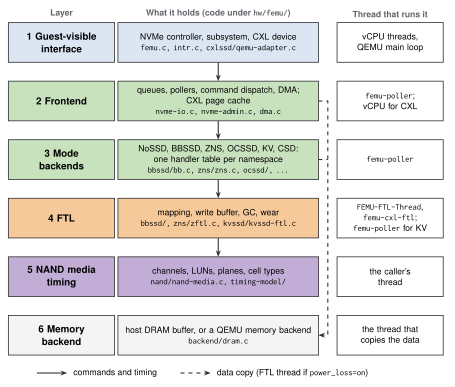
Figure: FEMU's six layers, the code that implements each one, and the thread that runs it; data is copied from the frontend straight to the memory backend, past the FTL and NAND model.
Solid arrows carry commands and timing. Dotted arrows carry the data, which goes straight to the memory backend.
| Layer | Main source files | Threads |
|---|---|---|
| 1. Guest-visible interface | hw/femu/femu.c, hw/femu/femu-props.c, hw/femu/intr.c, hw/femu/cxlssd/qemu-adapter.c | vCPU threads, QEMU main loop |
| 2. Frontend | hw/femu/nvme-io.c, hw/femu/nvme-admin.c, hw/femu/dma.c, hw/femu/lib/, hw/femu/cxlssd/cxlssd.c, hw/femu/cxlssd/cache.c | femu-poller, vCPU threads |
| 3. Mode backends | hw/femu/nossd/, hw/femu/bbssd/bb.c, hw/femu/zns/zns.c, hw/femu/ocssd/, hw/femu/kvssd/, hw/femu/csd/ | femu-poller |
| 4. FTL | hw/femu/bbssd/, hw/femu/zns/zftl.c, hw/femu/kvssd/kvssd-ftl.c | FEMU-FTL-Thread, femu-poller (KV), femu-cxl-ftl |
| 5. NAND media timing | hw/femu/nand/, hw/femu/timing-model/ | the caller's thread |
| 6. Memory backend | hw/femu/backend/dram.c; for CXL, a QEMU memory backend object | the thread that copies the data |
1. Guest-visible interface
FEMU registers three device types.
-device femu is a PCIe NVMe controller. It reports NVMe version 1.4 and
PCI ID 1d1d:1f1f by default (vid, did). BAR0 holds the controller
registers and the doorbells, MSI-X has one vector per queue plus the admin
queue, and an optional Controller Memory Buffer (cmbsz) must be placed on
BAR2 with cmbloc. femu_mode selects which kind of SSD the controller emulates (see
layer 3 and choosing a mode).
Namespaces are not separate devices. There is no FEMU namespace device to put
on the command line; the controller builds its namespaces at realize from
namespaces, namespace_sizes and namespace_modes, and Namespace
Management can add more at run time when ns_mgmt=on. Migration and
snapshots are blocked for this device.
-device femu-subsys is an NVMe subsystem. It is not on any bus. A
controller joins it with subsys=<id>, and the subsystem must appear first on
the command line. It is needed for Flexible Data Placement (fdp=on) and for
namespaces shared between controllers (ns_mgmt=on on the subsystem).
-device femu-cxl-ssd is a CXL Type-3 volatile memory device, a subclass
of QEMU's cxl-type3. Its data lives in the memory backend named by
volatile-memdev. FEMU installs an I/O region named femu-cxl-media over
every CXL fixed memory window that can reach the device, so guest loads and
stores to the device's address range reach FEMU. Optional extras are a cache
control interface on BAR5 (cca=on) and an experiment control channel through
the label storage area (lsa-control=on). A femu controller can serve the
same medium as an NVMe namespace with cxl_ssd=<id>.
Where it lives:
hw/femu/femu.c: QOM typesfemuandfemu-subsys,femu_realize(),nvme_check_constraints(), PCI and BAR setup, MMIO and doorbell handlers (nvme_mmio_write()).hw/femu/femu-props.c: the help text of thefemuandfemu-subsysproperties. The properties and their defaults are defined infemu.c(femu_props[]). The generated property reference is built from the binary.hw/femu/intr.c: MSI-X, MSI and pin interrupts (nvme_isr_notify_io()).hw/femu/cxlssd/qemu-adapter.c: QOM typefemu-cxl-ssd, realize checks, window overlay and address decoding, and its properties (cxl_props[]).hw/femu/cxlssd/props.c: their help text.
Threads: register and doorbell writes are MMIO exits handled on the vCPU thread that made them, under QEMU's big lock (BQL).
2. Frontend
NVMe queues and the admin path
The admin queue is handled synchronously. A write to the admin submission
queue doorbell calls nvme_process_sq_admin() on the vCPU thread, which runs
nvme_admin_cmd() in hw/femu/nvme-admin.c for each new entry. Commands the
generic code does not know go to the mode's admin hook, for example the BBSSD
vendor command 0xEF.
I/O queues are handled asynchronously. A write to an I/O submission queue
doorbell only stores the new tail (nvme_process_db_io()). The host can also
set up shadow doorbells with the standard Doorbell Buffer Config command
(nvme_set_db_memory()); a queue with a shadow doorbell is then read from
that buffer, and FEMU publishes EventIdx values so the host can skip doorbell
writes it does not need.
Pollers
When the host enables the controller, nvme_start_dataplane() creates the
poller threads (femu-poller) once. Each poller loops over the I/O queues it
owns (nvme_poller() in hw/femu/nvme-io.c). How many pollers there are is
set by two properties:
multipoller_enabled | Pollers | Queues per poller |
|---|---|---|
0 (default) | 1 | all I/O queues |
1 | ceil(queues / poller_ratio) | queues i, i + N, i + 2N, ... for poller i of N |
Any other value fails realize. A poller fetches commands from a queue without a lock, so every queue must have exactly one owner.
Each poller owns three structures, all indexed by poller number:
to_ftl[i]: a ring of requests waiting for timing.to_poller[i]: a ring of timed requests coming back from the FTL thread.pq[i]: a priority queue of timed requests, ordered by completion time.
The rings are in hw/femu/lib/rte_ring.c and the priority queue in
hw/femu/lib/pqueue.c.
I/O dispatch
For each new submission queue entry, nvme_process_sq_io():
- copies the command and stamps the request with the current host time
(
QEMU_CLOCK_REALTIME) as both its start time and its completion time; - calls
nvme_io_cmd(), which handles the commands every block mode shares (Flush, Dataset Management, Compare, Write Zeroes, Copy, Verify, Write Uncorrectable, I/O Management) and passes the rest to the namespace's mode (ns->ext_ops.io_cmd); - puts the request on
to_ftl[i].
For Read and Write on NoSSD, BBSSD and CSD, the mode handler calls
nvme_rw(), which checks the
command, maps the guest's PRP or SGL list (hw/femu/dma.c) and copies the
data between guest memory and the memory backend with backend_rw(). The data
transfer is finished at this point, on the poller thread, before any time has
been charged. ZNS and OCSSD have their own read and write paths that copy
to the same backend, and KV copies values into a store of its own.
On a NoSSD controller, NoSSD namespaces skip the rings: the poller posts the completion inside the same sweep, unless the host-link or firmware-CPU model is enabled.
Completion
nvme_process_cq_cpl() runs at the end of every sweep. It drains the timed
requests (from to_poller[i] when an FTL thread exists, otherwise straight
from to_ftl[i]), adds the optional host-link and firmware-CPU time, and
inserts them into pq[i]. Then it posts every request whose completion time
has passed and raises one interrupt per completion queue it posted to. A
request that is not due yet stays in the queue for the next sweep. This is
where FEMU enforces latency: nothing sleeps, the completion is simply not
posted before its time.
CXL accesses
The CXL device has no queues. A guest load or store to its range is an MMIO
access on the vCPU thread, routed through the host bridge and endpoint
decoders to femu_cxl_access() in hw/femu/cxlssd/cxlssd.c. A page-granular
cache (hw/femu/cxlssd/cache.c, policies fifo, lifo, clock, s3-fifo)
decides whether the access needs the FTL. The cache keeps only page numbers
and dirty bits; the data is always in the memory backend. With der=memslot
or der=cylon, cached pages can be mapped into the guest so that later
accesses do not reach QEMU at all (see the
CXL load walkthrough).
3. Mode backends
A mode is a table of handlers (FemuExtCtrlOps in hw/femu/nvme.h).
nvme_register_extensions() in hw/femu/femu.c installs the table for the
controller's femu_mode, and nvme_register_extensions_ns() gives each
namespace the table for its own mode, so one controller can mix modes with
namespace_modes. I/O commands are dispatched on the namespace's mode, not
the controller's.
| Mode | femu_mode | Code | What the I/O handler does | Where time is computed |
|---|---|---|---|---|
| OCSSD | 0 | hw/femu/ocssd/oc12.c (lver=1), hw/femu/ocssd/oc20.c (lver=2) | Open-Channel vector commands; the host runs the FTL | in the poller, from chip and channel timestamps (hw/femu/timing-model/timing.c) |
| BBSSD | 1 | hw/femu/bbssd/bb.c | Read and Write through nvme_rw() | FTL thread, bb_ftl_process_req() |
| NoSSD | 2 | hw/femu/nossd/nop.c | Read and Write through nvme_rw() | none |
| ZNS | 3 | hw/femu/zns/zns.c | zoned command set, zone state machine | FTL thread, zns_ftl_process_req() |
| CSD | 4 | hw/femu/csd/csd.c | computational storage commands plus block I/O | FTL thread for NAND; programs and compute-unit time on the femu-csd-cu threads |
| KV | 5 | hw/femu/kvssd/kvssd.c | key-value command set: Store, Retrieve, Delete, Exist, List | in the poller, through the BBSSD NAND model |
Features that are not modes:
- Flexible Data Placement: enabled on
femu-subsys; only BBSSD places data by reclaim unit (hw/femu/bbssd/ftl-fdp.c). - Several namespaces and per-namespace modes:
namespaces,namespace_sizes,namespace_modes(nvme_init_namespaces()inhw/femu/femu.c). - Namespace Management:
ns_mgmt=onon a NoSSD or BBSSD controller. - Metadata and protection information:
meta,mc,pi(hw/femu/nvme-pi.c), NoSSD and BBSSD only. - Streams:
streams=on(hw/femu/nvme-streams.c). - Persistent Event Log: always on, kept in
pel_fileif set (hw/femu/nvme-pel.c).
Choosing a mode lists which of these combine.
Threads: one FEMU-FTL-Thread per controller, started at realize only when a
namespace is BBSSD, ZNS or CSD, or the controller shares a BBSSD subsystem
(femu_needs_ftl_thread()). It reads every poller's to_ftl[i] ring, calls
femu_ftl_process_req(), adds the returned latency to the request's
completion time and puts it on to_poller[i]. A controller whose namespaces
are all NoSSD, OCSSD or KV has no FTL thread.
4. FTL
BBSSD
The BBSSD FTL in hw/femu/bbssd/ is a page-level device FTL. CSD uses it
unchanged, and the CXL SSD runs a private instance of it. Its state is
struct ssd (hw/femu/bbssd/ftl.h).
- Geometry. Channels (
nchs) hold LUNs (luns_per_ch), LUNs hold planes (pls_per_lun), planes hold blocks (blks_per_pl), blocks hold pages (pgs_per_blk) ofsecs_per_pgsectors ofsecszbytes. With the defaults a page is 4 KiB. A line (superblock) is the same block index on every plane of every LUN, so there areblks_per_pllines. - Write pointer. New pages are allocated from the current line in the order channel, then LUN, then plane, then page, so consecutive pages land on different channels and LUNs and can be programmed in parallel.
- Mapping (
mapping):page(default, a full table in memory),dftl(a cached mapping table ofmapping_cache_mbwhose misses cost NAND reads),hybridandfast(log-block schemes). Code:hw/femu/bbssd/ftl-map*.c. - Write buffer (
buffer_size, in pages): a DRAM buffer that accepts writes. Once it reachesbuffer_thres_pcent, the next write that needs a slot programs a batch of the least recently written pages. Withoutpower_lossit holds page numbers only, since the data is already in the memory backend. FUA writes and stream writes go straight to NAND, and Flush drains it. Code:hw/femu/bbssd/ftl-datapath.c. - Read cache (
read_cache_mb,cache_evict): a DRAM cache of recently read pages (hw/femu/bbssd/ftl-cache.c). - Garbage collection. After every request the FTL thread runs one
background GC pass if the share of lines in use has reached
gc_thres_pcent. A write that finds it atgc_thres_pcent_highfirst runs GC in the foreground until it drops below. The victim line is chosen bygc_policy(greedyby default). GC reads, programs and erases occupy the same LUNs as host I/O. Code:hw/femu/bbssd/ftl-line-gc.c. - Placement extras:
hot_cold_sepwrites overwritten pages to separate lines,read_reclaim_limitandretention_limit_secrewrite lines that were read too often or hold old data, and FDP maps reclaim units to lines. - Wear: each block counts its erases. SMART Percentage Used compares the
average erase count with
pe_cycles_rated,nand_bad_blockslowers Available Spare, andecc_step_nsmakes reads of worn or old blocks slower.
Entry point: bb_ftl_process_req() in hw/femu/bbssd/ftl.c, which dispatches
to ssd_read(), ssd_write(), ssd_trim() and the others in
hw/femu/bbssd/ftl-datapath.c.
Other FTLs
- ZNS (
hw/femu/zns/zftl.c): zones map onto blocks striped overzns_chnls_per_zonechannels. There is no device GC; the host resets zones. Writes collect in per-zone SRAM write caches (zns_num_wc) and are programmed when a cache fills or is evicted. Zone Reset erases the zone's blocks. - KV (
hw/femu/kvssd/kvssd-ftl.c): a hash index of keys, with values stored on NAND lines laid out with the BBSSD geometry and timing. - OCSSD has no device FTL. The host addresses channels, LUNs, blocks and pages directly.
Threads: FEMU-FTL-Thread runs the BBSSD, CSD and ZNS FTLs. The CXL SSD's
FTL runs on its own femu-cxl-ftl worker; when an NVMe controller is linked
with cxl_ssd=, both threads use the same FTL and take turns on one mutex.
5. NAND media timing
hw/femu/nand/nand-media.c turns one NAND operation into a completion time.
nand_media_op() takes a location (channel, LUN, plane, block, page), an
operation (read, program, erase) and a start time. It keeps a busy-until time
per LUN (BBSSD, CSD, KV) or per plane (ZNS): the operation starts when both
the request and that unit are ready, and the unit stays busy until it ends.
Units that differ run in parallel. A channel bus with command, data and status
phases is modelled only when one of those phases has a non-zero time.
Read, program and erase times come either from flat properties or from
built-in per-cell-type tables (hw/femu/nand/nand.h for BBSSD, CSD and KV;
hw/femu/zns/zns.h for ZNS). OCSSD uses the older
chip and channel timestamp model in hw/femu/timing-model/timing.c.
Timing model explains the rules and the properties that control them.
Threads: none of its own. It runs on whichever thread asks: the FTL thread
for BBSSD, CSD and ZNS, the poller for KV and OCSSD, and the femu-cxl-ftl
worker for the CXL SSD.
6. Memory backend
For femu, the data lives in one host buffer of devsz_mb MiB (the full
NAND capacity for BBSSD with op_pcent), allocated zero-filled at realize
and locked into RAM when RLIMIT_MEMLOCK allows (init_dram_backend() in
hw/femu/backend/dram.c). Namespaces are slices of it, packed back to back.
Controllers that share namespaces through a subsystem share one buffer. The
block modes read and write it with backend_rw(); KV keeps its values in a
separate buffer of its own. Nothing is written to a
file, so the contents are lost when QEMU exits. FEMU_MBE_INTERLEAVE controls
its NUMA placement (see the environment
variables).
For femu-cxl-ssd, the data lives in the QEMU memory backend object named by
volatile-memdev, for example -object memory-backend-ram,id=cxlmem,size=4G.
It must be a non-zero multiple of 256 MiB and at most 120 GiB. der=cylon
needs a shared, preallocated hugetlbfs backend. The vCPU thread copies data
to and from it directly. A femu controller linked with cxl_ssd= uses this
backend instead of allocating its own.
Threads
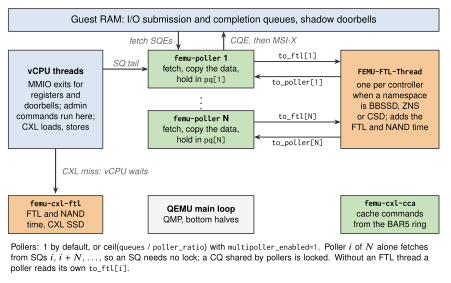
Figure: FEMU's threads and the queues between them: vCPUs store doorbells, each poller owns its submission queues and its to_ftl/to_poller rings, and one FTL thread per controller times BBSSD, ZNS and CSD requests.
| Thread name | Created by | How many | Runs |
|---|---|---|---|
| vCPU threads and the QEMU main loop | QEMU | one per vCPU, plus one main loop | MMIO: controller registers, doorbells, admin commands; CXL accesses and their media wait; QMP and monitor commands |
femu-poller | nvme_start_dataplane() when the host enables the controller | 1, or ceil(queues / poller_ratio) | I/O command fetch and execution, data copy, completion and interrupts |
FEMU-FTL-Thread | femu_realize() | 0 or 1 per controller | BBSSD, CSD and ZNS FTL and NAND timing |
femu-cxl-ftl | femu_cxl_start() | 1 per femu-cxl-ssd with ftl=on | FTL and NAND timing for cache misses and write-backs |
femu-cxl-cca | femu_cxl_cca_start() | 1 per femu-cxl-ssd with cca=on | cache control commands from BAR5 |
femu-csd-cu | csd_init() | nr_cu per controller with a CSD namespace | CSD programs (Execute) and their compute-unit time |
Where latency is charged and enforced
| Device or mode | Computed in | Enforced by |
|---|---|---|
| NoSSD | nothing to compute | completion posted in the same sweep |
| BBSSD, CSD, ZNS | FEMU-FTL-Thread adds the FTL's latency to the completion time; for a CSD Execute, the femu-csd-cu thread that ran the program adds its compute-unit time instead | the poller posts once the time has passed |
| OCSSD, KV | the poller, while executing the command | the poller posts once the time has passed |
Host link, firmware CPU (pcie_bandwidth_mbps, pcie_prop_delay_ns, fw_cpu_ns) | the poller, before queueing the completion | same |
femu-cxl-ssd | femu-cxl-ftl returns the media time of a miss or write-back | the vCPU waits it out before the load or store completes |
I/O walkthrough: one 4 KiB write on BBSSD
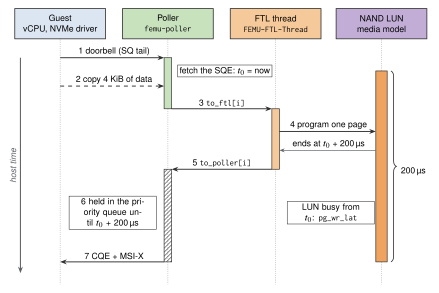
Figure: One 4 KiB write on BBSSD over host time: the poller copies the data at fetch, the FTL thread books a 200 µs program on the LUN from that moment, and the poller holds the completion until it is due.
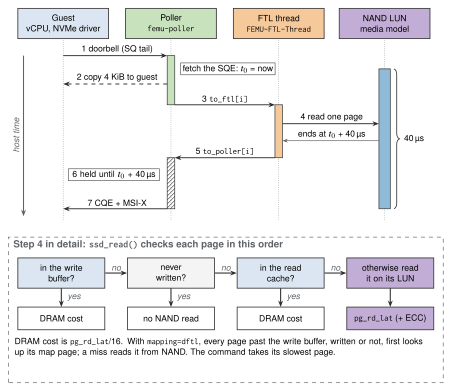
Figure: One 4 KiB read on BBSSD: the guest buffer is filled at fetch and only the completion waits; below, the checks ssd_read() makes for each page and what each one costs.
Assume the defaults: femu_mode=1, one poller, buffer_size=0, 4 KiB pages,
pg_wr_lat=200000 (200 us), no channel bus model.
- Submit. The guest NVMe driver writes the command into its submission
queue in guest memory and writes the new tail to the queue's doorbell. The
vCPU exits to QEMU, and
nvme_process_db_io()stores the tail. Nothing else happens on the vCPU. - Fetch and copy. The poller sees the new tail on its next sweep.
nvme_process_sq_io()copies the command and stamps it with the current timet0.nvme_io_cmd()passes it tobb_io_cmd(), which callsnvme_rw(): the LBA range and size are checked, the PRPs are mapped, andbackend_rw()copies the 4 KiB from guest memory into the memory backend at the namespace's offset. The data is now where later reads will find it. - Hand to the FTL. The poller puts the request on
to_ftl[1]and goes on with other queues. - Time it. The FTL thread takes the request and calls
bb_ftl_process_req(), which callsssd_write(). If too few lines are free, foreground GC runs first. The one logical page is mapped to the next physical page at the write pointer, the old copy (if any) is marked invalid, andssd_advance_status()asks the media layer for a program on that page's LUN. If the LUN is idle the program takes 200 us fromt0; if it is busy untilt1, it ends att1+ 200 us. The LUN stays busy until then. If enough lines are now in use, one background GC pass follows; its NAND operations make the LUNs they use busy for later requests. - Return. The FTL thread adds the latency to the request's completion
time and puts it on
to_poller[1]. - Hold. On a following sweep,
nvme_process_cq_cpl()moves the request into the priority queue. It stays there until the host clock passes its completion time. - Complete. The poller writes the completion entry into the guest's completion queue and, at the end of the sweep, raises the queue's interrupt. The guest sees the write complete about 200 us after the poller fetched it on an idle device.
With buffer_size set, step 4 puts the page in the write buffer instead and
charges a DRAM access (pg_rd_lat / 16, 2.5 us with the defaults). The
program happens on a later write that pushes the buffer past its threshold,
and that write pays for it.
CXL load walkthrough
The guest loads 8 bytes from a femu-cxl-ssd region at host physical address
hpa. With the cache on (cache-pages > 0):
-
Trap. Unless the page is mapped directly (below), the load exits to QEMU on the vCPU thread. The
femu-cxl-mediaoverlay routes it through the window, host bridge and endpoint decoders to a device address, and callsfemu_cxl_access(). -
Hit. If the page is in the cache, no media time is charged. The vCPU copies the 8 bytes from the memory backend and returns. The cost is the MMIO exit itself, paid on every access.
-
Miss. The page must be brought into the cache:
- The page is read from NAND: the vCPU drops the BQL, queues a read for the
femu-cxl-ftlworker, and waits for the latency it returns. A page the FTL has never mapped costs nothing to read. - If the page's set is full, the policy evicts a victim. A dirty victim is written back, which costs a NAND program.
femu_cxl_delay()waits out the rest of the media time, sleeping until 100 us before the deadline and spinning for the rest, with the BQL dropped so other vCPUs keep running.- The vCPU copies the data from the memory backend. With
prefetch-degreeset, the next pages are inserted into the cache with no NAND read.
A store follows the same path and marks the page dirty. A store miss reads the page first, as a write-allocate cache does.
- The page is read from NAND: the vCPU drops the BQL, queues a read for the
What happens to the next access to the same page depends on der:
der | After a miss or hit | Next access to the page |
|---|---|---|
off (default) | nothing | traps again; a hit with no media time |
memslot | the page is mapped as a one-page KVM memory slot alias (at most 1024 for all devices) | goes straight to host memory with no exit and no time charged; the page counts as dirty, so its eviction costs a program |
cylon | the page is mapped by writing the guest's EPT entry through a Cylon host kernel | goes straight to host memory; dirty state comes from EPT dirty bits |
A direct mapping is removed when its page is evicted, flushed or invalidated,
and the next access traps again. Both direct modes map pages only in the
single-endpoint topology the design note describes; elsewhere accesses stay
on MMIO. der=memslot fails realize under TCG. der=cylon fails realize
without cylon-kernel-ack=on, and falls back to MMIO with a warning when the
Cylon host kernel or the hugetlbfs backend is missing. The CXL SSD design note gives the details.