FEMU documentation
This page is hw/femu/docs/README.md at FEMU 39a55eeb6 (2026-10-02), licensed GPL-2.0-or-later. Send corrections to the FEMU repository.
Start with the goal you have. What changed since the last release is in the changelog.
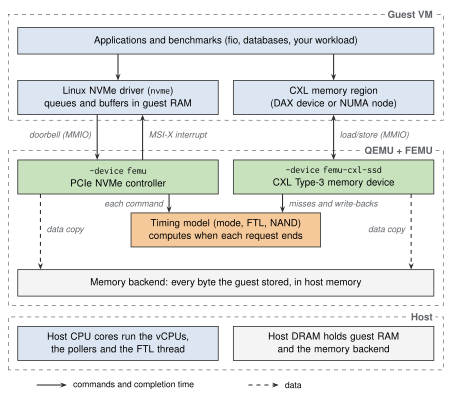
Figure: Where FEMU sits: the guest drives FEMU's NVMe or CXL device, the timing model decides when each request completes, and the data goes straight to the memory backend in host memory.
I am new to FEMU
Read these in order:
- Requirements: host OS, KVM, memory, and the guest kernel each mode needs.
- Build: dependencies,
femu-compile.sh, optional features, common build errors. - Guest image:
make-guest-image.sh, other ways to get an image, SSH access. - Quick start: build, boot a BlackBox SSD, run fio and read the write amplification factor.
I want to learn by doing
The tutorials walk through nine tasks in a real guest, with the output each step should print: a first SSD, GC and WAF, ZNS, FDP, latency tuning, several namespaces, KV, CXL memory and configuration files.
I want a specific kind of SSD
Choosing a mode has the full decision table:
every femu_mode value, the settings for each goal, which features combine,
and what the guest needs. In short:
| Goal | Mode | Launcher | Guide |
|---|---|---|---|
| A fast NVMe drive with no FTL timing | NoSSD (femu_mode=2, the default) | run-nossd.sh | NoSSD |
| A conventional SSD with a device FTL, GC and WAF | BlackBox SSD (femu_mode=1) | run-blackbox.sh | BlackBox |
| A Zoned Namespace SSD | ZNS (femu_mode=3) | run-zns.sh | ZNS |
| A host-managed OpenChannel SSD | OCSSD (femu_mode=0) | run-whitebox.sh | OCSSD |
| A key-value SSD | KV (femu_mode=5) | none | KV |
| Computational storage | CSD (femu_mode=4) | run-csd.sh | CSD, CSD guest tools |
| Flexible Data Placement | BBSSD with femu-subsys,fdp=on | run-blackbox-fdp.sh | FDP |
| Create and delete namespaces from the guest | NoSSD or BBSSD with ns_mgmt=on | none | Namespace management |
| Per-block metadata and protection information | NoSSD or BBSSD with meta, mc, pi=on | none | Metadata and PI |
| Several namespaces on one controller | any NVMe mode | none | Several namespaces |
| A CXL memory-semantic SSD | femu-cxl-ssd device | run-cxlssd.sh | CXL SSD, design note |
| Guest control of the CXL SSD cache: pin, drop, uncached ranges | femu-cxl-ssd,cca=on | run-cxlssd.sh | CXL caching API |
| The CXL SSD medium also as an NVMe namespace | femu,femu_mode=1,cxl_ssd=<id> | run-cxlssd.sh plus -device femu,... | CXL NVMe link |
The guest kernel each mode needs is in requirements.md.
I want to look up a parameter or counter
- Device properties: every
-device femu,femu-subsysandfemu-cxl-ssdproperty, generated from the binary. - Parameter manual: the parameters grouped by component, with units, valid values, interactions and worked configurations.
- Runtime properties: QOM properties and
counters you read or set with
qom-getandqom-set. - Log pages and counters: vendor log C0h (WAF and media counters), telemetry, supported log pages, asynchronous events, keeping the Persistent Event log in a file.
- Changelog: what changed since femu-v9.0.1, including properties that are now refused and settings whose effect changed.
- Scripts and tools: every shipped script and tool, its arguments and environment variables, and which ones are legacy.
I want to understand how FEMU works
- Architecture: the layers from the guest interface to the memory backend, the threads, and a walk through one NVMe write and one CXL load.
- Choosing a mode: which mode or feature fits a goal, and which ones combine.
- Timing model: how latency is computed and enforced, the properties that control it, and how to measure it.
- Security and limits: what a guest can do to the host, migration and snapshots, property compatibility, host sizing.
- CXL SSD design: the design note for
femu-cxl-ssd.
I want the full design
The design manual has one chapter per component, each with diagrams, data structures, algorithms, parameters, counters, limits and a source map:
- Overview and NVMe frontend: the component hierarchy, queues, pollers, dispatch and completion.
- BlackBox FTL and NAND media and timing.
- ZNS, FDP and namespaces and subsystems.
- OCSSD, KV, CSD, NoSSD and CXL SSD.
The same pages, with figures, are collected in one PDF: the FEMU Manual. The Markdown pages are the reference when the two differ.
I want to measure or tune
- Measuring: WAF and counters from log page C0h, SMART, CXL counters, fio recipes per mode, repeatable numbers.
- Performance tuning: pollers, CPU pinning, hugepages, NUMA, host settings, and what each knob trades.
Something does not work
- Troubleshooting and FAQ: answers to the 18 most common questions from the issue tracker.
- Debugging: where messages go, gdb, compile-time debug switches, common crash reports, what to put in a bug report.
- Build errors.
I want to change FEMU
- Testing: unit tests, the qtests, the documentation checks, guest-side tests, and how to add a test.
- Keeping the documentation correct: the generated references, the mode table and the example checks.
- Code structure: what lives where under
hw/femu/, and where to start a change. Architecture explains how the parts work together. - Contributing: style, tests, sign-off and pull requests.
hw/femu/scripts/gen-property-docs.pyregenerates the property reference, andhw/femu/scripts/check-doc-links.pychecks that every relative link in the docs resolves. CI runs both.
How to cite
If you use FEMU in your research, cite the FAST '18 paper. The BibTeX entry is in the README, and CITATION.cff has the same entry for citation tools. If you use FDP, the CXL SSD or CSD, also cite the paper that mode comes from: WARP (FAST '26), Cylon (FAST '26) or CEMU (ASPLOS '26).