S5: CXL memory access
Question: How does a memory access reach a storage model?
Time: 30 minutes. Prerequisites: completed setup. See qualification and limitations before running.
Mechanism
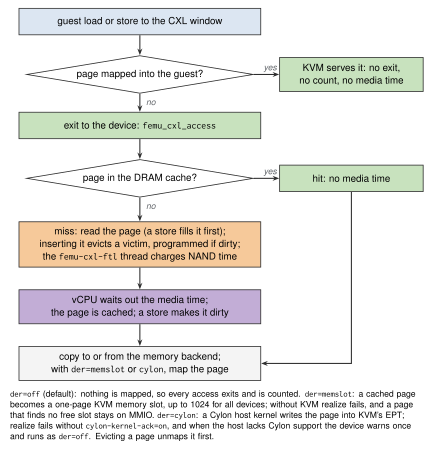
- The guest discovers the CXL topology and creates a RAM region.
- Keep the region in devdax mode for a bounded explicit mapping.
- Compare readback and device counters across a controlled access pattern.
Predict
Which cache must miss before a load reaches the emulated device?
Write down a predicted state or counter change before executing the commands.
Run
Host terminal, unless a command is explicitly labelled Guest. Source and
export the identity fields from connection.env. These labs overwrite the
explicit disposable namespace. Use a fresh VM for each independent arm.
# Host: use the CXL-specific image and the recorded QMP socket.
LAB="$PWD/labs" QMP="$RUN_DIR/qmp.sock" bash labs/bin/lab-s5-cxl.sh
Check your evidence
- A real devdax region is created and mapped.
- Written bytes read back correctly.
- The receipt contains before/after cache counters and their scope.
The host runner retrieves raw receipts and preserves the guest exit status. Keep unsuccessful attempts; do not replace them with a later successful log.
Interpret
What would need to change before claiming calibrated load latency?
Explain the mechanism and the measurement boundary. A throughput number by itself is not evidence that the intended feature was exercised.
Recover
- Region creation fails: check guest config and decoder topology.
- Device is system RAM: stop; do not force-convert memory in use.
- No counter change: check CPU caching and whether the mapping was accessed.
Save the receipt before resetting the VM.
Materials and source
Slides, scripts and worksheet.
Videos are not yet recorded. The frozen public source is
1918eb9795ba.
The FEMU Manual explains the implementation and supported properties.