S2: Placement with FDP
Question: Can lifetime hints reduce relocation?
Time: 30 minutes. Prerequisites: completed setup. See qualification and limitations before running.
Mechanism
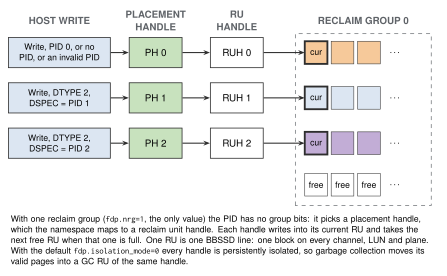
- The host supplies placement identifiers with writes.
- FEMU resolves the handle inside its endurance group.
- The device still owns mapping and garbage collection.
Predict
Predict whether hot and cold writes sharing a reclaim unit increase copied pages.
Write down a predicted state or counter change before executing the commands.
Run
Host terminal, unless a command is explicitly labelled Guest. Source and
export the identity fields from connection.env. These labs overwrite the
explicit disposable namespace. Use a fresh VM for each independent arm.
bash labs/bin/preflight.sh labs/guest/lab-s2-fdp.sh /dev/nvme0n1 0
# Restart with a fresh overlay, same configuration.
bash labs/bin/preflight.sh labs/guest/lab-s2-fdp.sh /dev/nvme0n1 1
Check your evidence
- All fio jobs finish with CRC verification enabled.
- Both arms write exactly 16 GiB after the same full fill.
- Compare interval counters; a lower WAF is not a pass requirement.
The host runner retrieves raw receipts and preserves the guest exit status. Keep unsuccessful attempts; do not replace them with a later successful log.
Interpret
When would lifetime separation provide no benefit?
Explain the mechanism and the measurement boundary. A throughput number by itself is not evidence that the intended feature was exercised.
Recover
- Missing generic NVMe device: check the guest kernel and nvme driver.
- Unknown FDP option: verify the pinned fio build supports io_uring_cmd.
- No GC activity: revisit occupancy before interpreting placement.
Save the receipt before resetting the VM.
Materials and source
Slides, scripts and worksheet.
Videos are not yet recorded. The frozen public source is
1918eb9795ba.
The FEMU Manual explains the implementation and supported properties.