NAND and controller timing
FEMU computes completion deadlines from resource-availability clocks. The
shared NandMedia layer accepts a normalized location and an operation; each
mode that uses it supplies its geometry, timing values, gating policy, and
accessors to its availability state. The black-box FTL (and the CSD, KV and
CXL SSD modes built on it) and ZNS use this layer; OpenChannel keeps its own
timing model in timing-model/timing.c.
This page keeps worked examples. For the per-mode charges, every timing property and the run-time timing commands, see the manual's timing model and NAND timing design.
Array scheduling
With optional bus phases disabled, an ordinary black-box operation behaves as:
start = max(request_start, LUN_available)
finish = start + operation_latency
LUN_available = finish
latency = finish - request_start
Different LUNs can overlap. Default black-box timing gates on the LUN, so adding planes does not automatically create independent per-plane read/program engines. ZNS uses a plane gate. OpenChannel does not go through this layer. A common API therefore does not make the modes' concurrency models identical.
For ordinary black-box multi-page requests, the request latency is generally the maximum of its page costs, with serialization captured in shared clocks. There is no cycle-by-cycle NAND waveform simulation.
Worked example: two LUNs and three reads
Consider three single-page NAND reads with pg_rd_lat=40000 ns. The array
clocks start idle; channel phases, extra ECC cost, suspend, caches, GC, and
controller-link costs are excluded. Times below are relative to the first
read's arrival. These are calls to the media scheduler, not a claim that three
arbitrary logical addresses map to these LUNs.
| Read | LUN | Arrival | Array starts | Finishes | Returned latency |
|---|---|---|---|---|---|
| A | 0 | 0 µs | 0 µs | 40 µs | 40 µs |
| B | 0 | 10 µs | 40 µs | 80 µs | 70 µs |
| C | 1 | 10 µs | 10 µs | 50 µs | 40 µs |
For B, the scheduler computes max(10, 40) + 40 = 80 µs and returns
80 - 10 = 70 µs. For C, the other LUN is idle, so it returns only the 40 µs
array cost. A standalone check against nand_media_op() verified
all three latencies and finish times. This checks six arithmetic outcomes;
it does not measure guest latency or validate a workload's physical placement.
Enabling channel phases adds a second shared resource, so different LUNs can still contend for the same channel. Enabling read-cache hits can bypass these array operations entirely. Use the read-path diagram to establish which operations reach the scheduler before comparing timings.
Channel-bus phases
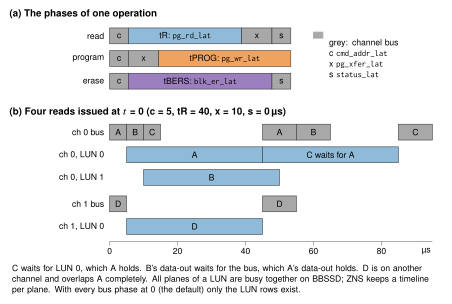
Any nonzero cmd_addr_lat, pg_xfer_lat, or status_lat enables staged channel
scheduling for black-box mode. ch_xfer_lat supplies the transfer duration when
pg_xfer_lat is zero. All durations are nanoseconds.
The program path reserves command/address, data transfer, and array time; it does not add the read/erase status phase. Read data-out reserves a future bus window after array completion, allowing another operation to use the bus during the read's array phase. Each channel holds up to 32 future reservations; beyond that, the implementation falls back to more conservative immediate booking.
For ZNS, use zns_cmd_addr_lat, zns_pg_xfer_lat, and zns_status_lat. Leaving
them at zero keeps channel accounting off while preserving the plane gate.
Flat timing and cell-type timing
| Setting | Effect |
|---|---|
| Default black-box | pg_rd_lat=40000, pg_wr_lat=200000, blk_er_lat=2000000 ns |
nand_cell_type=1..4 | Select SLC, MLC, TLC, or QLC tables and paired page types |
nand_cell_type=0,pgtype_lat=1 | Multiply flat program time by a row selected through cell_pages |
cell_pages=1..5 | Bits-per-cell row for the optional flat multiplier model |
zns_flash_type | ZNS cell table; SLC, TLC, and QLC have built-in timing |
zns_pg_rd_lat, zns_pg_wr_lat, zns_blk_er_lat | Explicit ZNS timing overrides |
Table-based black-box timing disables the additional flat pgtype_lat
multiplier, avoiding double application. Enabling pgtype_lat without a
cell_pages value defaults that multiplier model to TLC. A nonzero black-box
cell type also restricts pages per block to the supported pairing-table size.
ZNS MLC or PLC needs all three explicit array latencies because their built-in
entries are absent. Use integer property values, not strings such as qlc.
ECC cost, age, and suspend
Black-box ECC is an extra read-time model:
tiers = min(4, floor(erase_count / 750)
               + floor(line_age_seconds / ecc_retention_sec))
extra_read_ns = tiers × ecc_step_ns
The age term is present only with nonzero ecc_retention_sec. Age is measured
from line closure, not each page's individual program time. ecc_step_ns=0
disables the added latency. No payload bits are corrupted or decoded by this
model. Read-triggered refresh is a separate policy.
pe_suspend=1 lets a read interrupt modeled program/erase occupancy, paying
tsusp_ns and extending the suspended work's completion. Reads do not preempt
other reads. ZNS exposes corresponding zns_pe_suspend and zns_tsusp_ns.
The standalone tests cover both plain and staged-channel variants.
Shared API versus reachable feature
| Mechanism | Reachable behavior at this revision |
|---|---|
| Multi-plane operation API | Black-box line GC, FDP GC and KV reclaim invoke it for grouped erase; ordinary reads/programs are not batched |
tplebsy | Inter-plane erase busy time on that grouped path |
tplpbsy, tplrbsy | No effect; reads and programs are issued one plane at a time. A value other than the default warns at realize |
nand_media_copyback | Implemented and unit-tested, but no production caller was found |
trcbsy and NAND page-register cache-read logic | API support exists, but no mode enables the cache-read model. trcbsy has no effect and a value other than the default warns at realize |
DRAM read_cache_mb | Separate, reachable black-box read-cache model |
The full list of accepted properties that do nothing is in the manual's security and limits page.
Host link and firmware
pcie_bandwidth_mbps uses MB/s, despite the lowercase property spelling.
Transfer cost is bytes × 1000 / bandwidth ns. Reads and writes reserve separate
transmit and receive timelines. pcie_prop_delay_ns adds propagation time, and
fw_cpu_ns serializes eligible commands on one firmware-service timeline.
These costs are applied in the completion path after existing request timing;
this is a service-time abstraction, not a detailed PCIe packet model.
Setting either link knob or fw_cpu_ns also takes NoSSD requests off the pure
inline path. Record these settings when comparing NoSSD throughput. CSD compute
execution has a separate compute-unit scheduling model described on its page.
Worked example: link directions and shared firmware
Use the NoSSD link recipe: 4000 MB/s bandwidth, 1000 ns propagation, and 500 ns firmware service. Suppose all resource clocks start at zero, three 4 KiB requests enter this stage with deadline zero, and the handler processes write A, write B, then read C in that order.
| Request | Link service interval (ns) | After propagation (ns) | Firmware interval (ns) | Final deadline (ns) |
|---|---|---|---|---|
| A: write | RX 0–1024 | 2024 | 2024–2524 | 2524 |
| B: write | RX 1024–2048 | 3048 | 3048–3548 | 3548 |
| C: read | TX 0–1024 | 2024 | 3548–4048 | 4048 |
The two writes share RX availability. The read uses a separate TX clock, but all three reserve the same firmware timeline in handler order. Thus C can wait behind B even though its link stage ends earlier. Processing A, C, then B instead gives final deadlines 2524, 3024, and 3548 ns respectively. Record queue/poller configuration when interpreting this ordering effect.
Propagation is added to a request's deadline without reserving additional link time. Setting bandwidth to zero removes transfer time; a nonzero propagation delay still enables the link model and disables NoSSD inline completion. Integer division truncates fractional nanoseconds.
These examples follow nvme_process_cq_cpl(). Its link branch handles Read and
Write opcodes, including KV's shared opcodes using xfer_bytes. The firmware
branch also includes Zone Append. Zone Append does not enter this link branch,
so these two controls have different command scope.
Interpreting accuracy
Calibrate geometry, latencies, transfer costs, and workload conditions together. A device-mode label or a default table is not a calibration for a particular commercial SSD. Report host CPU configuration, queueing, warm-up, preconditioning, and source revision alongside modeled settings. Compare both modeled deadlines and guest-observed latency when host overhead is significant.
Implementation sources
Reviewed against FEMU 39a55eeb6. The examples describe this revision; see validation coverage.
- nand/nand-media.c: availability, staged bus, ECC, suspend, multi-plane and copyback
- nand/nand-media.h: media configuration and 32-reservation bound
- bbssd/ftl-media.c: black-box adapter and timing selection
- zns/zftl.c: ZNS plane gate and bus adapter
- nvme-io.c: host-link and firmware timing
- tests/unit/test-nand-media.c: tested timing scenarios