Key-value
This page traces the KV-SSD implementation through the source. For launch lines, guest commands, limits and verification, use the KV-SSD guide in the FEMU Manual.
femu_mode=5 exposes a key-value command set with Store, Retrieve, List, Delete,
and Exist handlers. Each KV namespace has its own key index and value store.
Use kv.conf and drive the controller through passthrough.
An ordinary block-device benchmark does not exercise these operations.
Internal design
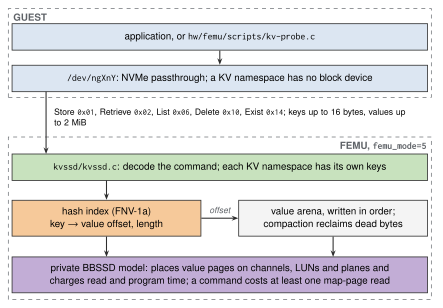
The implementation uses an index over keys and a log-append value area, with
separate physical-page tracking. Compaction moves live values when reclaimable
space is needed. Media reads and programs contribute timing; namespace state
is protected by a mutex. This is its own KV path, not ordinary black-box
mapping=hybrid or gc_policy applied to opaque values.
Keys are at most 16 bytes in the implemented wire format. The default maximum value is 2 MiB, subject to command transfer validation. Store supports store-if-key-exists and store-if-no-key-exists. Retrieve can return a shorter buffer while reporting the full value length in the completion result.
Store, overwrite, and deletion
kvssd_ftl_store() checks conditional-store flags, the key limit, and logical
capacity before reserving value space. Logical occupancy counts live key bytes
plus live value bytes and subtracts the replaced entry when checking an update.
The append frontier separately determines whether a contiguous value fits.
After reserving space, Store copies guest bytes into the arena and programs new modeled pages. It then publishes the index entry and invalidates the replaced page list. An overwrite leaves the old byte range reclaimable. Delete removes the index entry, invalidates its pages, and updates occupancy; it does not move the remaining values immediately.
| Operation | Value bytes and index | Modeled media work |
|---|---|---|
| Store or overwrite | Append bytes, then publish offset, length, and page list | Program new value pages; invalidate replaced pages |
| Retrieve | Copy min(value length, host buffer size) bytes; report full length | Read only pages touched by the transferred span |
| Delete | Remove key and mark its old byte range reclaimable | Invalidate old pages and charge command/index costs |
| Compaction | Pack live values in old-offset order and rewrite offsets | Program replacement pages as GC_IO, then invalidate old lists |
When compaction runs
kv_value_alloc() first tries the unused tail of the arena. If the new value
does not fit and reclaimable bytes exist, it calls kv_compact() while holding
the namespace lock. Compaction gathers live entries, checks physical-page
availability, and sorts by old byte offset so values can move downward safely.
Each entry receives a new page list; memmove() packs its bytes when needed.
After a successful pass, the append frontier equals the sum of live value
lengths and reclaimable bytes become zero. The pending allocation is retried.
For example, storing two 4 KiB values, overwriting the first, and deleting the second leaves one live 4 KiB value and 8 KiB of reclaimable arena space. Those operations alone do not trigger compaction while the tail still has room. Apply enough further allocation pressure to reach the compaction branch before comparing reclamation costs. A capacity error can also reflect unavailable physical pages or a failed allocation during compaction, so live-byte occupancy alone does not explain every failure.
Compaction programs all live entries, including an entry whose byte offset is
already at the new frontier. Count modeled GC writes separately from bytes
actually moved by memmove(). Ordinary black-box gc_policy is not the selector
for this value-arena compaction path.
Configure and exercise
-device femu,femu_mode=5,devsz_mb=4096,namespaces=1
The download makes the shared geometry explicit. FDP plus KV is refused because FDP's reclaim-unit allocation conflicts with the KV write path. Geometry validation applies, but KV handles capacity and reclamation through its own implementation.
Copy hw/femu/scripts/kv-probe.c from the FEMU source into the Linux guest.
Use a dedicated test controller with KV namespace ID 1: the probe hard-codes
that namespace ID, whichever node is supplied. It stores and deletes the key
hello, so an existing value under that key is not preserved.
Compile successfully before invoking the probe:
gcc -O2 -o kv-probe kv-probe.c && sudo ./kv-probe /dev/nvme0
The probe takes the node as its argument (default /dev/nvme0) and uses the
32-bit I/O passthrough ioctl, which works on the controller node and on the
generic node /dev/ngXnY that Linux 6.0 and later create for a KV namespace.
The controller node refuses I/O passthrough when the controller has more than
one namespace; the KV-SSD guide gives the kernel
requirement and which node to use. The probe tests Store, Exist, full and
short Retrieve, conditional-store behavior, deletion, and missing-key status. Inspect its output for both command status and payload
checks. Success ends with KVPROBE_DONE fails=0 and exit status 0. A failed
check yields status 1; failure to open the controller yields status 2. Capture
the exit status immediately after running the command, and retain failed output.
The probe continues after individual failed checks, so failure does not imply
that it left the key unchanged.
The probe also checks rejection of a key longer than 16 bytes. It does not
exercise List, multiple namespaces, compaction under capacity pressure, or
persistence across emulator restarts. For guest-tested Store, Retrieve, Exist,
List and Delete commands with captured output, follow
tutorial 07. Do not expect /dev/nvme0n1 to appear:
Linux attaches no block device to a KV namespace.
For measurements, report key count, key/value sizes, update ratio, occupancy, and compaction activity. Distinguish index cost, payload-copy work, and modeled NAND timing; a functional command-set implementation is not a performance calibration for a commercial KV SSD.
Implementation sources
Reviewed against FEMU 39a55eeb637b. The examples describe this revision; see validation coverage.
- kvssd/kvssd.c: wire decoding and command dispatch
- kvssd/kvssd-ftl.c: index, value append, physical pages, and compaction
- kvssd/kvssd-admin.c: KV Identify data
- scripts/kv-probe.c: guest command and payload checks