Architecture
FEMU separates the NVMe command interface, the policy that maps logical data onto flash, and the model that schedules media operations. Payload bytes live in a DRAM backend. Mapping and media metadata determine placement and modeled latency; they do not turn the backend into persistent NAND.
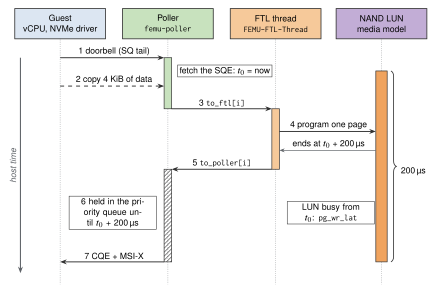
Request and completion path
The diagram shows the FTL-thread path. KV and OpenChannel run their own handlers
and timing paths. CSD programs run on their own femu-csd-cu compute-unit
threads, and a black-box controller linked to a CXL SSD with cxl_ssd=<id>
hands its requests to that medium's FTL. The manual's
architecture page lists every thread, including
the CXL SSD's. A pure NoSSD controller can complete eligible I/O inline in
the poller when hiops_inline=on and the optional link and firmware models are
off. Mixed namespaces are dispatched by the request's namespace, so a black-box
namespace on a NoSSD controller still receives FTL processing.
A request starts with stime and expire_time set to the current realtime
clock. The FTL computes reqlat and adds it to expire_time. The poller uses a
priority queue to post the completion when that deadline is due. Host CPU
scheduling can delay an actual completion beyond the modeled deadline.
multipoller_enabled and poller_ratio control poller allocation; they do not
create one FTL worker per namespace. multipoller_enabled=0 runs one poller for
all I/O queues, 1 runs one poller per poller_ratio queues, and any other
value fails realize. queues takes 1 to 2047 queue pairs. More pollers
therefore do not imply that mapping and GC execute in parallel.
Black-box data and policy boundaries
A logical-to-physical table and reverse map remain the source of truth for page, DFTL, hybrid, and FAST mapping. Their differences are translation costs, allocation classes, and merge behavior. A line spans one block index across all channels, LUNs, and planes. Closing a line puts it on a full list or a victim queue; invalidating pages changes its collection priority.
Write buffering tracks logical pages awaiting modeled programming. The read cache tracks pages whose repeated reads can avoid modeled NAND access. Both operate over payload data held separately in host memory. See policies for the actual order and scope of the cost models.
Read path
The following decisions run for each logical page in ssd_read. A buffer hit
skips both translation and NAND. A read-cache hit skips the data NAND read,
but the DFTL translation-cache access has already happened.
The request returns the maximum accumulated latency, with NAND operations sharing media availability clocks. The arrows show execution order, not an unconditional sum of every stage's latency. Cache hits also skip the refresh trigger checks below the NAND read. An unmapped page skips data NAND timing; under DFTL it can still incur a translation-cache access.
Write and destage paths
ssd_write first handles forced-GC pressure and attempts a queued refresh.
It then chooses buffered admission or direct programming. This diagram shows
the successful paths; exhausted allocation space returns Capacity Exceeded on
either path.
Destaging selects the least recently written pending page and checks free space and forced GC as it progresses. Hybrid/FAST reclaim runs once per direct write request or completed destage batch when needed. FUA bypasses buffering for the request's pages; it does not flush unrelated pending pages. A write carrying a Streams directive is also programmed directly. Flush uses the destage path with an unlimited page budget. Payload bytes remain in the separate DRAM backend throughout these metadata and timing operations.
Namespace isolation and shared resources
Each namespace receives a backing-store slice and its own extension state. The controller still owns queues, pollers, the FTL thread, and optional link and firmware timelines. Two namespaces are therefore not equivalent to two independent controllers when measuring contention.
namespace_modes and namespace_sizes require exactly one nonempty entry per
namespace. QEMU command-line list commas must be doubled; the INI helper escapes
them automatically. FDP is restricted to a single namespace. OpenChannel must
be selected at the controller level and is also restricted to one namespace.
A controller takes at most one CSD namespace. KV and FDP cannot share the same
subsystem configuration. Each namespace_sizes entry is rounded down to whole
logical blocks (a KV namespace to a sector), and the sizes may add up to all of devsz_mb. The manual's
choosing a mode
page lists every combination rule.
Where to extend the implementation
Device realization and namespace initialization
femu_realize creates controller resources before initializing each namespace.
The controller retains its mode's callbacks for administrative and startup
paths. Each namespace receives a callback table for its own mode, with the
state pointer cleared before its initializer runs.
The current initializer signature is
void init(FemuCtrl *, NvmeNamespace *, Error **). It reports failure through
the error output, not an integer return value. Keep namespace state independent:
copying an initialized state pointer would alias mappings or key spaces between
namespaces. FemuExtCtrlOps also includes admin_cmd_cqe for administrative
handlers that need completion data; inspect the current header before adding a
mode rather than copying an older callback definition.
On a controller that shares its namespaces through a femu-subsys with
ns_mgmt=on, the second and later controllers skip the per-namespace loop and
use the subsystem's namespaces. A controller with cxl_ssd=<id> attaches to the
CXL medium just before the FTL thread decision.
Successful realization does not prove that a guest has created queues or run I/O. Initialization tests and guest workload tests cover different stages.
Device shutdown and partial initialization
The shutdown arrows below show call order in femu_exit, not I/O completion
guarantees. Pollers produce work for the shared FTL worker, so shutdown joins
the pollers first. Both must stop before mode state or communication rings
are released.
Between the FTL worker and the mode callbacks, femu_exit also closes the
persistent event log and detaches a linked CXL SSD. A controller that uses a
subsystem's shared namespaces skips the mode callbacks, namespace release and
DRAM free, because the subsystem owns them.
FemuExtCtrlOps.exit takes a controller, not a namespace. The dispatcher
collects distinct exit function pointers from the controller and namespace
tables; it calls a shared handler once even when several namespaces use it.
Each handler must release the namespace state it owns. The separate
ns_exit callback, which only the black-box mode sets, releases one namespace's
state when that namespace is released. A new mode must account
for mixed-mode controllers and partially initialized namespaces.
Initialization failures take the separate femu_realize_undo path. It invokes
mode cleanup before releasing the namespace array, subsystem registration,
backing memory, and other allocated resources. The shared FTL worker starts
only after every namespace initializer succeeds, so this rollback precedes
worker startup. Do not infer that the normal shutdown sequence runs on an
initialization failure.
For a lifecycle change, test failed initialization after earlier namespaces have succeeded, exit before the guest enables the controller, and removal after I/O. Check retained allocations and worker access to released state. These are validation cases to run; source ordering alone does not establish leak freedom or completion of outstanding guest commands.
Extension locations
| Change | Primary location | Contract to preserve |
|---|---|---|
| Add a device property | femu.c | Validate it before allocation and initialization |
| Add a mapping scheme | bbssd/ftl-map.c and femu_mapping_ops | Translate, prepare/commit writes, relocate, trim, and teardown |
| Add a GC policy | bbssd/ftl-line-gc.c | Remove selected victims from the correct queue and maintain counts |
| Add NAND scheduling behavior | nand/nand-media.c | Shared operation timing and adapter-selected policies |
| Change a mode's command handling | Mode directory and extension operations | Validate namespace, bounds, transfer sizes, and completion status |
| Add an experiment counter | nvme-admin.c and FemuStatsLog | Preserve the public log layout and units |
The timing guide explains why the same media API can produce different behavior in different modes.
Implementation sources
Reviewed against FEMU 39a55eeb6. The examples describe this revision; see validation coverage.
- femu.c: femu_ftl_thread, femu_ftl_process_req, namespace initialization
- nvme.h: FemuExtCtrlOps and namespace state
- nvme-io.c: submission processing, DMA, completion scheduling
- backend/dram.c: volatile payload storage
- bbssd/ftl-map.c: mapping operation registry
- bbssd/ftl-datapath.c: read ordering, buffered admission, direct programming, and destaging